Where I Put UGC on Shopify Product Pages So It Actually Helps
A practical Shopify product page audit for reviews, customer photos, shoppable video, schema, and Liquid placement without slowing the page down.
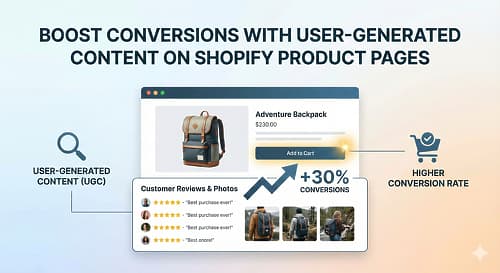
Short answer: UGC works on Shopify product pages when it answers buyer doubt near the decision point. A review widget buried below six sections is not trust building. A noisy carousel above the add-to-cart button is not trust building either. The job is to show the right proof at the right moment without making the page slower or harder to buy from.
When I audit a Shopify PDP, I treat UGC as product evidence, not decoration. I look for the doubts a shopper has before purchase: fit, size, color, durability, delivery, return risk, and whether the product looks the same outside studio lighting. Then I place customer proof beside those doubts.
The Product Page Slots I Check First
- Near the title: review count and rating summary, linked to the review section.
- Near variant selection: fit, sizing, shade, material, or compatibility proof.
- Below the media gallery: customer photos that show real use, not only campaign images.
- Before the long description: one or two specific reviews that handle objections.
- Near FAQs or returns: reviews that mention delivery, support, exchanges, or care.
I do not start by asking which review app is best. I start by asking where the shopper needs proof. The app is just plumbing.
A Lightweight Liquid Pattern
If the theme owns a small amount of curated proof, I prefer a section that reads from product metafields. That keeps the best customer quote editable in the Shopify admin and avoids waiting for a third-party script before any proof appears in the HTML.
{% assign quote = product.metafields.proof.customer_quote.value %}
{% assign author = product.metafields.proof.customer_name.value %}

{% if quote != blank %}
  <section class="product-proof" aria-label="Customer proof">
    <blockquote>
      <p>{{ quote | escape }}</p>
      {% if author != blank %}
        <cite>{{ author | escape }}</cite>
      {% endif %}
    </blockquote>
  </section>
{% endif %}
This does not replace a full reviews app. It gives the product page one server-rendered proof point while the app loads the full review stream. That matters for shoppers, search crawlers, and answer engines that evaluate the initial HTML.
Review Content Should Not Be Invisible
A common Shopify issue is that all review text arrives after JavaScript runs. The visual page looks fine, but the HTML has no review content, no review count, and no product proof. For SEO and AEO, that is a weak implementation. I want at least the rating summary, one selected quote, and structured product data available without relying entirely on client-side rendering.
{
  "@context": "https://schema.org",
  "@type": "Product",
  "name": "Example product",
  "aggregateRating": {
    "@type": "AggregateRating",
    "ratingValue": "4.8",
    "reviewCount": "147"
  }
}
Only output review schema when the visible page actually shows the same review evidence. Marking up ratings that shoppers cannot see is the wrong tradeoff.
What I Would Avoid
- Auto-playing video blocks above the buy box on mobile.
- Review widgets that shift the layout after load.
- Screenshots of reviews instead of real text.
- Generic five-star quotes that do not mention the product.
- Putting every UGC block below recommendations where most shoppers never scroll.
My PDP UGC Checklist
- The first viewport shows rating count or a clear proof signal.
- At least one useful customer quote is server-rendered or present in initial HTML.
- Photo/video UGC is lazy-loaded below the primary buying controls.
- Review schema matches visible content and is not inflated.
- The theme reserves space for widgets to avoid layout shift.
- Negative reviews are not hidden; they are answered or used to improve copy.
Sources
- Shopify product page guidance: https://www.shopify.com/blog/product-page
- Google product structured data documentation: https://developers.google.com/search/docs/appearance/structured-data/product
How I Decide Which Reviews to Surface
The best review is not always the longest or the most positive. I look for reviews that answer a specific pre-purchase objection. For apparel, that might be fit and fabric. For supplements, it might be taste and routine. For furniture, it might be assembly, delivery, and how the color looks in a real room.
- Choose one review that explains product fit or use case.
- Choose one review that mentions delivery, packaging, or support.
- Choose one customer photo that shows scale better than studio media.
- Avoid vague quotes like great product unless the surrounding page already has enough detail.
- Rotate proof by product type instead of using the same quote everywhere.
Performance Guardrails
UGC widgets can hurt the same page they are supposed to help. If the review app injects large JavaScript, blocks rendering, or moves content after load, the conversion benefit can be offset by a slower mobile page. I check widget weight, layout shift, lazy loading, and whether the buy box remains usable while reviews load.
{% comment %}Reserve space so a late-loading widget does not shift the page.{% endcomment %}
<div class="reviews-shell" style="min-height: 280px">
  <div id="reviews-widget" data-product-id="{{ product.id }}"></div>
</div>
AEO Angle: Answer the Buyer Question Directly
Answer engines do not need a carousel full of generic praise. They need clear product facts and visible evidence. If customers repeatedly mention sizing, ingredients, compatibility, or durability, turn that into page content: a fit note, material table, compatibility list, care section, or FAQ that is backed by the reviews.
What I Would Measure After Adding UGC
- Add-to-cart rate on product pages with and without surfaced proof.
- Review-anchor clicks from the first viewport.
- Scroll depth to the review section.
- Mobile Core Web Vitals before and after widget changes.
- Return reasons connected to expectations the reviews were supposed to clarify.
That turns UGC from a trust badge into a measurable merchandising system. The goal is not more widgets. The goal is fewer unanswered doubts before checkout.
Want this built for you instead of DIY?
I'm Karan — a Top Rated Plus Shopify Expert ($300K+ earned, 100% Job Success). If you'd rather hand this to someone who's done it hundreds of times, let's talk.
🛠️E-commerce Tools You Might Like
Tags
📬 Get notified about new tools & tutorials
No spam. Unsubscribe anytime.
Comments (0)
Leave a Comment
No comments yet. Be the first to share your thoughts!