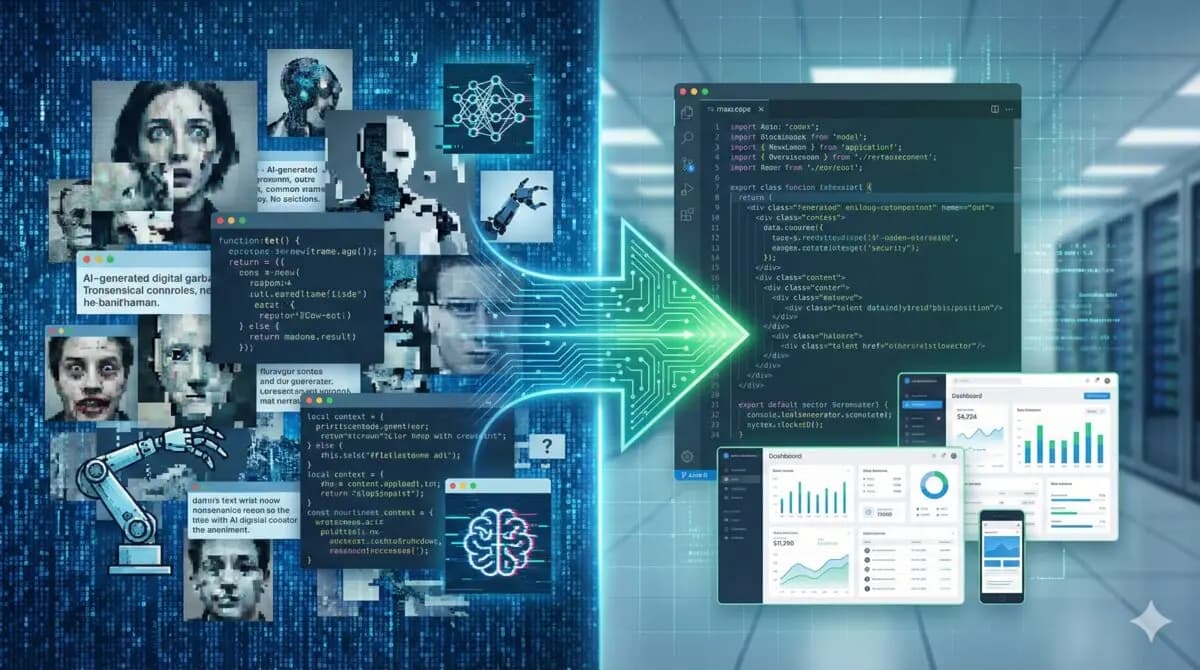
Node.js Creator Says 'Humans Writing Code is Over': What It Means for the Future of Development
Ryan Dahl, creator of Node.js, predicts the end of humans writing source code. Here's what that actually means for developers and the industry.

The Context: Syntax vs. Semantics
When Dahl says "writing code is over," he is specifically referring to the manual labor of typing out syntax. For decades, software engineering has been conflated with the act of writing lines of text in files. We memorize standard libraries, we wrestle with semicolons, and we spend hours on boilerplate that has been written a thousand times before.
Generative AI has fundamentally broken this loop. Large Language Models (LLMs) like GPT-4, Claude, and specialized coding assistants (GitHub Copilot, Cursor) have demonstrated that machines are now better at the act of coding than humans are. They don't forget imports. They don't make syntax errors. They can scaffold an entire microservice in seconds.
From Writer to Editor
This shift transforms the role of a developer from an author to an editor—or perhaps more accurately, an architect.
In the near future, we won't be judged on how fast we can type a React component. We will be judged on our ability to:
- Orchestrate AI Agents: Can you direct a suite of AI tools to build a cohesive system?
- Verify Integrity: Can you spot the subtle hallucinations in AI-generated logic?
- System Design: Can you architect scalable, secure solutions that AI can then implement?
I see this daily in my work with Shopify clients. I used to spend days writing custom Liquid templates. Now, I describe the functionality I need, and AI generates 80% of the code. My value isn't in that 80%; it's in the remaining 20%—optimizing performance, ensuring security, and aligning the technical solution with the client's business goals.
The Impact on E-commerce and Business
For business owners and e-commerce entrepreneurs, this is incredible news. The barrier to entry for complex technical features is collapsing.
- Faster Time-to-Market: Features that used to take weeks can now be prototyped in days.
- Lower Costs: Maintenance becomes easier when AI can explain legacy code and suggest fixes.
- Democratization: You no longer need a massive engineering team to build a custom app. A single skilled developer leveraged with AI can do the work of a small team.
However, this also introduces risk. Code generated without understanding is technical debt waiting to explode. The "human in the loop" is more critical than ever to ensure safety and reliability.
How to Survive (and Thrive) in the Post-Code Era
If you are a junior developer or looking to break into the industry, do not panic. Instead, pivot.
- Learn High-Level Concepts: Focus on system architecture, database design, and cloud infrastructure. Syntax is cheap; structure is expensive.
- Master Prompt Engineering: Learning to communicate effectively with an LLM is the new "learning to code."
- Focus on Problem Solving: Code was always just a means to an end. The end is solving a user's problem. Keep your eyes on that.
Conclusion
Ryan Dahl is right: the days of manually typing function main() { ... } are numbered. But the era of software engineering is just getting started. We are moving up the abstraction ladder, leaving the assembly line of code generation to become the designers of the future.
Don't fear the AI. Master it.
How I would apply this
The way I would make this practical is to turn the advice into a decision path. Node.js Creator Says 'Humans Writing Code is Over': What It Means for the Future of Development needs clear checks, failure modes, and one next action the reader can apply immediately.
I would treat this as a real production decision: define the expected behavior, name the risk, make the smallest useful change, and verify the result with evidence from the page, command, metric, or support case.
Review checklist
- State the decision the reader needs to make.
- Add one concrete example.
- Explain the common mistake.
- Give a validation step.
- Link the advice to the next practical action.
Failure modes
- The post stays at opinion level.
- The reader cannot tell what to do next.
- The examples are not specific enough.
- The validation step is missing.
Review block
Quality check for Node.js Creator Says 'Humans Writing Code is Over': What It Means for the Future of Development:
- What changed for the reader?
- What proof supports the advice?
- What should be avoided?
- What is the next practical action?
I keep this kind of note short so it can be reused during review without becoming another document nobody reads.
What I would improve next
The next upgrade I would make is to add a real artifact: screenshot, command output, before/after table, benchmark, source link, or QA note. Those details give the page more authority and make it more useful to answer engines.
For a shorter post, I would add depth through one tested example rather than filler. One good edge case or validation note is more useful than another generic overview.
- One real example from the workflow.
- One edge case that breaks the simple advice.
- One metric or signal to watch after the change.
- One clear action the reader can take today.
A concrete example to keep
For Node.js Creator Says 'Humans Writing Code is Over': What It Means for the Future of Development, I would keep one concrete example in the page so the advice does not stay abstract. The example should show the starting state, the decision being made, the check I would run, and the signal that tells me the change worked. That makes the content more useful for readers and more defensible for SEO/AEO because it demonstrates practical experience instead of repeating a general claim.
- Starting state: what the store, app, workflow, or codebase looks like before the change.
- Decision point: what the reader needs to choose or fix.
- Validation: the command, screenshot, metric, support ticket, or QA step that proves the change.
- Risk: the edge case that could still fail in production.
- Follow-up: the next improvement I would make after the first pass is stable.
Bottom line
The practical takeaway is to apply the checklist to one real case first. If it improves that page, workflow, client conversation, or production bug, then it is worth scaling.
Review path for nodejs-creator-humans-writing-code-is-over-analysis:
1. Pick one real example.
2. Apply the checklist.
3. Record before/after evidence.
4. Watch one metric or failure signal.
5. Keep or revert based on the result.Want this built for you instead of DIY?
I'm Karan — a Top Rated Plus Shopify Expert ($300K+ earned, 100% Job Success). If you'd rather hand this to someone who's done it hundreds of times, let's talk.
🛠️Generative AI Tools You Might Like
Tags
📬 Get notified about new tools & tutorials
No spam. Unsubscribe anytime.
Comments (0)
Leave a Comment
No comments yet. Be the first to share your thoughts!