Headless Commerce: Is It Worth the Hype? A Complete Guide for 2024
Exploring whether headless commerce delivers on its promises. A deep dive into costs, benefits, and real-world implementation for e-commerce businesses.
Most Stores That Go Headless Shouldn't Have
I've built both kinds of Shopify stores: standard Liquid themes and fully headless storefronts on Next.js and Hydrogen. So when a client opens a call with "we want to go headless," my first question is usually some version of "why?" — and about three times out of four, the honest answer is "we read it makes sites faster" or "our last agency said our theme was holding us back." Neither of those is a reason to take on a headless build.
Headless is a real architecture with real upside. It's also the single most over-prescribed decision in ecommerce right now. I've watched brands torch six figures rebuilding things Shopify already gave them for free, then spend the next year paying developers to maintain a checkout funnel they could've had out of the box. Let me walk through where headless actually earns its keep, and where it quietly bankrupts your roadmap.
What "headless" actually means in practice
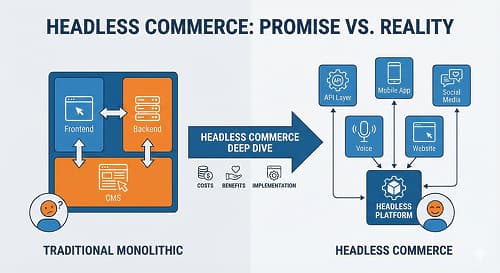
You split the storefront (the part customers see and click) from the commerce engine (products, inventory, orders, checkout). The two talk over an API. On Shopify that's the Storefront API, usually GraphQL.
Your front end becomes its own application — React, Next.js, Hydrogen, whatever — that fetches data and renders the UI however you want. Shopify still runs the boring, load-bearing stuff: catalog, cart logic, checkout, payments. You're not replacing Shopify. You're replacing the theme layer on top of it.
That distinction matters, because a lot of the "freedom" people imagine they're buying is freedom from the theme, not from the platform. And the theme is the cheap part to change.
What people are actually buying when they pay for it
A front end with no guardrails
This is the honest draw. Liquid themes, even with Online Store 2.0 sections, live inside Shopify's rendering model. Go headless and that ceiling disappears. You can build interactions, transitions, and layouts that a theme just can't express cleanly.
I won't pretend that's nothing. For a brand whose entire pitch is the experience — a product configurator, a heavily art-directed editorial flow, something genuinely interactive — that ceiling is a real constraint. For a store selling 40 SKUs of supplements, it's a ceiling you'll never touch.
One backend, many fronts
The omnichannel pitch: same catalog and orders feeding a website, a native app, kiosks, whatever else. This is legitimately where headless shines, and it's the cleanest case for it. If you're maintaining a React Native app and a web store and you're sick of keeping two sources of truth in sync, decoupling the front end is the right call. One Storefront API, multiple consumers.
If your "omnichannel strategy" is a website and an Instagram shop, you don't have this problem.
Speed (with an asterisk)
Headless front ends can be very fast. Server rendering, edge caching, tight JS bundles — sub-second loads are achievable. But "can be" is carrying the whole sentence. A badly built Next.js storefront with a waterfall of unbatched GraphQL calls and a 600KB hydration bundle is slower than a decent Liquid theme, and I've audited plenty of them.
Speed is an outcome of discipline, not architecture. A well-tuned Online Store 2.0 theme already scores well on Core Web Vitals. Before anyone spends headless money chasing performance, I'd point them at my breakdown of Shopify speed work that actually moves conversions — most of those wins are available without rearchitecting anything. If you do go headless, the performance ceiling is higher, but you have to earn it; the same Next.js optimization fundamentals apply.
"Future-proofing"
The theory: swap the front end without touching the backend, never get locked in. In practice you're trading platform lock-in for framework lock-in. Your custom Next.js app is the thing that needs maintaining now, and React major versions and framework migrations don't pause because your roadmap is busy. You haven't removed risk. You've moved it onto your own payroll.
The bill nobody quotes upfront
It costs more. A lot more, and forever.
A solid custom Liquid theme is a finite project. A headless build is a product you now own and operate. You're rebuilding things that ship free with a theme: cart, search, filtering, account pages, collection logic, structured data, the lot.
I won't throw made-up dollar figures at you, because they vary wildly by scope. But the shape is consistent: headless costs meaningfully more to build and substantially more to keep alive. The build is the down payment. Maintenance is the mortgage.
You inherit the maintenance you used to outsource
With a standard store, Shopify ships updates, security patches, and platform features and you do nothing. Headless, that's your team's job: dependency updates, framework upgrades, breaking Storefront API changes, browser quirks, the works. Skip it for a year and you've got a stale, vulnerable codebase that's painful to touch. You need a developer on retainer or in-house. Permanently. Budget for it or don't start.
You lose a pile of free stuff
Going headless on Shopify, you walk away from things that just worked:
- Theme-dependent apps — a big chunk of the ecosystem assumes Liquid and silently won't work
- Built-in SEO conveniences and automatic structured data you'll now hand-roll
- Native internationalization and multi-currency behavior in the storefront
- Anything that hooked into theme events
Checkout is the exception worth knowing. You keep Shopify's hosted checkout regardless — and on Plus you customize it through checkout extensibility rather than rebuilding it. If you're weighing a headless move, understand what checkout extensibility lets you do in 2026 before you assume you need to own that layer. You almost certainly don't.
Analytics turns into engineering work
On a theme, GA4 and the Pixel and most tracking tools drop in. Headless, every ecommerce event is something you wire up and babysit as the code changes. Tracking that used to be a checkbox becomes a small project with its own bugs — and broken attribution quietly costs you ad money.
Slower to launch
A standard store can be live in weeks. A headless build is months, minimum, and longer if scope creeps. If you're testing a market or racing a competitor, that lead time is the cost, and it's a real one.
Who should go headless
Go headless if you genuinely fit here:
- You're running a real app-plus-web operation and want one commerce backend behind both. This is the strongest case.
- The experience is the product — configurators, deep editorial-commerce blends, interactions a theme physically can't render.
- You have engineering capacity, permanently — in-house or a committed long-term partner. Not a one-time agency build and goodbye.
- You're at a scale where the math works — high enough revenue that a fractional conversion lift on a custom funnel outpays the build and the ongoing burn.
- You've already hit the theme's real limits — not imagined ones. You've pushed Online Store 2.0 to its edge and there's a concrete wall in front of you.
Who shouldn't (most of you)
- Small to mid-size stores with normal needs. Selling physical products, standard checkout, a catalog and some content pages? A good theme does this beautifully. The juice isn't worth the squeeze.
- Anyone who needs to move fast. Validating a product or a market? Ship on a theme, learn, then decide if you've earned the complexity.
- Teams with no developers. Shopify is built for merchants. Headless is built for engineers. Without one, a headless store becomes a liability the day it launches.
- Anyone whose reason is "headless is modern." That's not a problem statement. If you can't name the specific thing your current platform won't do, you're not ready, and you may never need to be.
Plenty of brands convince themselves their theme is the bottleneck when the real issue is a slow theme, a bloated app stack, or unoptimized images. Before rearchitecting, find out what's actually on your store — you can check what theme and apps a site runs and often the fix is a cleanup, not a rebuild.
The middle ground most people actually want
The choice isn't binary, and the hybrid options solve the real problem for far less.
Hydrogen on Oxygen. Shopify's own React framework, hosted on Shopify's edge. You get a modern component-driven front end and keep managed checkout and backend, with far less plumbing than a from-scratch Next.js stack. For brands that want the headless feel without owning every wire, this is usually where I steer them.
Partial headless. Go custom on the pages that matter — homepage, a flagship PDP, a configurator — and leave the rest on the theme with native checkout. You get the differentiation where customers actually notice it and skip the cost everywhere they don't.
Just push Online Store 2.0 harder. Sections, blocks, and metafields cover an enormous amount of "we need something custom." Half the headless projects I've been pulled into could've been a well-built 2.0 theme and a couple of custom sections. Exhaust this first. It's cheap and it's fast.
Before you commit, answer these honestly
- What specific thing can't my current setup do? Name it. If you can't, stop here.
- Can I fund both the build and the maintenance, indefinitely? It's a mortgage, not a purchase.
- Who maintains this in eighteen months? If there's no clear answer, don't start.
- Can I afford the timeline? Months, not weeks.
- What free features am I giving up, and can I live without them? List them honestly.
- What number justifies this? Define the KPI before you spend, not after.
So is it worth the hype?
Headless isn't hype and it isn't a default. It's a sharp tool for a narrow set of jobs: true multi-front-end operations, experience-led brands, and teams with the scale and engineering to run it. For everyone else — which is most of ecommerce — modern Shopify already does the job, and going headless mostly buys you cost, complexity, and a maintenance burden you'll resent.
My actual advice to most clients: exhaust the platform first. Push 2.0 to its limits, fix the speed problems you actually have, lean on a developer who'll bend Liquid further than you'd expect. If you still hit a real wall, go headless deliberately — start with an MVP, ship one custom surface, measure it, and expand. The headless builds that succeed are evolutionary. The ones that blow up tried to rebuild everything at once because a blog post told them to.
Pick based on the problem in front of you, not the architecture that's trending. Sometimes the most advanced option is simply the wrong one for your store.
Is headless commerce only for large enterprises?
No, but size is a decent proxy for whether it fits. The real test isn't revenue — it's whether you have a concrete need a theme can't meet and the engineering capacity to run a custom front end long-term. A small brand with a genuinely unique, experience-driven product and a developer on hand can absolutely justify it. A large brand selling standard products through a standard funnel often can't. Match the architecture to the problem, not to the size of the company.
Want this built for you instead of DIY?
I'm Karan — a Top Rated Plus Shopify Expert ($300K+ earned, 100% Job Success). If you'd rather hand this to someone who's done it hundreds of times, let's talk.
🛠️E-commerce Tools You Might Like
Tags
📬 Get notified about new tools & tutorials
No spam. Unsubscribe anytime.
Comments (0)
Leave a Comment
No comments yet. Be the first to share your thoughts!