The SaaSpocalypse: How Anthropic Claude Cowork Plugins Caused a $285 Billion Software Stock Crash
Anthropic released 11 Claude plugins. $285B vanished from software stocks. Shopify -29%, Figma -40%.
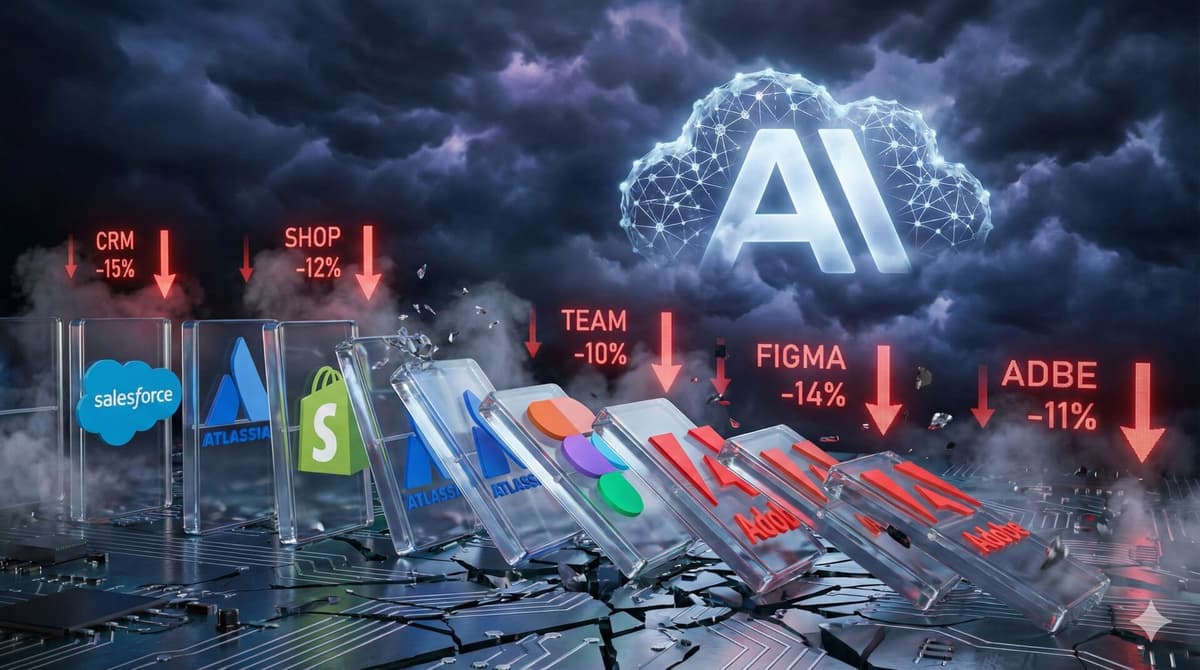
A software moat used to be the workflow. You bought Thomson Reuters or DocuSign not because the underlying logic was hard, but because someone had wrapped it in a product, a contract, and a sales team. Anthropic just showed that the wrapper is the cheapest part. They published a set of plugins, and the market repriced an entire category of software in a week.
The Damage
The numbers are ugly:
- Thomson Reuters: Down 15%
- Figma: Down 40% (YTD)
- Atlassian: Down 35%
- Shopify: Down 29%
- DocuSign: Down 11%
- Salesforce: Down 7%
- Adobe: Down 7%
Even Indian IT giants weren't spared. Infosys ADRs dropped 5.5%, Wipro fell nearly 5%.
What Anthropic Actually Shipped
This is the part that should bother software executives more than the stock chart. The plugins are structured prompts and workflow configurations. No proprietary legal AI model. No special reasoning engine. It's Claude with better instructions.
The plugins cover:
- Legal workflows (contract review, NDA triage, compliance)
- Sales and marketing automation
- Finance and data analysis
- Customer support
- Product management
The legal plugin lit the fuse. It automates contract review, compliance checks, and legal briefings, the exact tasks Thomson Reuters charges premium prices for. There's no clever IP being unlocked here. The product was always a prompt with a logo on it, and now everyone can see that.
If you've spent any time wiring AI into real workflows, none of this is shocking. The hard part was never the model call. It was the packaging, the trust, and the distribution. Anthropic owns two of those three.
Why Markets Panicked
The story flipped overnight.
Before: AI helps software companies build better products.
Now: AI replaces software companies entirely.
Jefferies called it plainly: "Trading is very much get-me-out style selling."
But the technology isn't the signal. The strategy is. Anthropic moved from selling the model to owning the workflow. When Claude was just an API, you built on top of it and Anthropic took its cut. Now Anthropic publishes the vertical solution itself, and the platform you were building on is the competitor sitting across the table.
That's the shift that matters. Every company renting intelligence from a model provider should ask what stops that provider from shipping their product next.
The Counterargument
Plenty of people think the panic is overdone.
Jensen Huang (Nvidia CEO): "The most illogical thing in the world. AI will use existing software tools, not replace them. Would you use a screwdriver or invent a new screwdriver?"
Sundar Pichai (Google CEO): Companies seizing the moment with AI will find opportunity, not obsolescence.
Box CEO Aaron Levie: "This is the most exciting moment we have ever had." (His stock is down 17% anyway.)
I lean toward Huang on the durable point and the market on the near-term one. AI won't delete software, but it absolutely deletes the margin on software whose only job is to run a workflow you can describe in a paragraph. Those are different claims, and the people downplaying the crash keep blurring them.
What This Means If You're in the Shopify Ecosystem
Here's the part I actually care about, because it's where I work:
- Shopify stock is down 29% YTD, but the business fundamentals haven't changed
- AI tools are eating into services. Routine development work is under automation pressure
- Specialization gets more valuable. Custom solutions, deep integrations, and expert consulting are harder to automate
- Speed matters more. Anthropic went from Cowork launch to plugins in 3 weeks
The companies bleeding worst are the ones selling commoditized workflows. The rule is brutal and clean: if your work can be described in a prompt, it's at risk.
So I've stopped selling things that fit in a prompt. The work that survives is the messy, store-specific integration. The multi-tenant architecture that has to hold up under real load. The judgment about where an automated step will quietly corrupt someone's order data. A plugin can draft a contract review. It can't own the consequences when the integration touches money.
The Bigger Picture
Anthropic didn't need a breakthrough to rattle markets. It showed what Claude could already do and hit publish.
Claude Code crossed $1 billion in annualized recurring revenue by November, months after launch. Anthropic is now raising at a $350 billion valuation, up from $61.5 billion in March 2025.
The iteration speed is the real story. Enterprise companies spend quarters on releases like this. Anthropic did it in weeks. If you're a software exec, that's the number to lose sleep over, not the stock price. The cadence is the threat.
This is also why I treat the model less like a competitor and more like a power tool. The developers I see thriving are the ones already building agents and RAG pipelines on top of these models instead of waiting to find out whether they're the screwdriver or the thing being replaced.
Will the SaaSpocalypse lead to AI replacing software companies?
Not everyone thinks so. Industry leaders like Jensen Huang and Sundar Pichai argue AI augments existing software tools rather than replacing them. But the market's reaction to Anthropic's plugins shows real, growing concern that AI could disrupt the traditional software industry and shift how companies operate and invest in technology. My read: it won't replace software, it'll replace the easy money in software. That's still a big deal if the easy money was your business model.
How I'd Actually Evaluate This
When I read an AI story like this, I split it into three buckets: what's confirmed, what's likely, and what still needs a human looking at it. A stock crash is confirmed. "AI replaces SaaS" is a prediction wearing a confirmed number as a costume.
If I were putting one of these plugins into a real workflow, I'd treat it like any production decision. Define the expected behavior, name the risk, make the smallest useful change, and verify the result with actual evidence, a page, a command, a metric, a support case. Not a demo.
AI safety checklist
- Use primary sources for factual claims.
- Keep AI-generated output behind human review where there's real risk.
- Log prompts and decisions when the workflow touches customers.
- Don't send data the task doesn't need.
- Measure whether AI made the workflow safer or just faster.
Where these stories go wrong
- They treat a demo as production proof.
- They hide the data and review assumptions.
- They trust model output without validation.
- They predict a lot and teach almost nothing.
AI review block
AI review checklist for the SaaSpocalypse plugin story:
- Separate confirmed facts from prediction.
- Name the data source.
- Describe the failure mode.
- Keep a human review step.
- Measure the workflow after shipping.
I keep notes like this short so they actually get reused during review instead of becoming another doc nobody opens.
What I'd validate next
The upgrade I'd make to any take like this is a real artifact: a screenshot, command output, a before/after table, a benchmark, a source link, a QA note. Those are what give a page authority, and they're what answer engines reward.
For a shorter post I'd add depth through one tested example, not filler. One good edge case beats another generic overview every time.
- One real example from the workflow.
- One edge case that breaks the simple advice.
- One metric to watch after the change.
- One thing the reader can do today.
Keeping it grounded
For market-shock AI stories, separate the narrative from the operating reality. A dramatic valuation move is useful context, but the durable lesson is how software companies protect trust when AI features touch customer workflows, pricing, data, or uptime. I'll update this page with primary-source links as the event develops.
- Separate confirmed numbers from commentary.
- Name which software category got hit.
- Explain the actual workflow risk.
- Don't treat one market move as proof of a permanent trend.
- Give operators a practical response, not a panic.
Want this built for you instead of DIY?
I'm Karan — a Top Rated Plus Shopify Expert ($300K+ earned, 100% Job Success). If you'd rather hand this to someone who's done it hundreds of times, let's talk.
Tags
📬 Get notified about new tools & tutorials
No spam. Unsubscribe anytime.
Comments (0)
Leave a Comment
No comments yet. Be the first to share your thoughts!