LLVM's New AI Policy: Why "Human in the Loop" is the Future of Coding
LLVM sets a new standard for AI-assisted development by mandating a "human in the loop" for all contributions. Here's what this means for the future of coding.
The LLVM Policy: A Breakdown
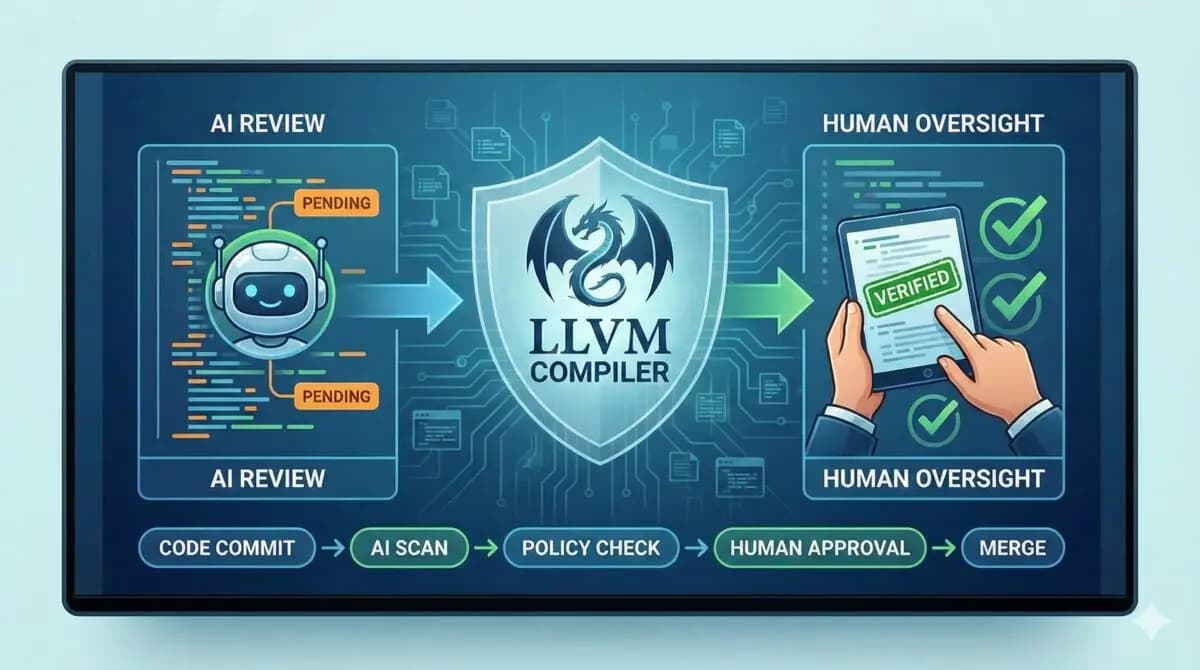
The core of LLVM's new guideline is simple yet profound: Contributors must take full responsibility for the code they submit, regardless of whether it was written by a human or generated by an AI.
Specifically, the policy emphasizes that:
- Blind submission is forbidden: You cannot simply copy-paste output from an LLM (Large Language Model) into a pull request.
- Verification is mandatory: The contributor must understand the code, verify its correctness, and ensure it meets the project's style and quality standards.
- Accountability remains human: If the AI hallucinates a bug or introduces a security vulnerability, the human committer is the one held accountable.
This move addresses a growing concern in the open-source community: the flood of low-quality, AI-generated spam PRs that waste maintainers' time and degrade codebase integrity.
Why "Human in the Loop" Matters
1. Quality Control and Maintainability
LLMs are probabilistic, not deterministic. They guess the next likely token based on training data. While often impressive, they can be confidently wrong—producing code that looks correct but fails in edge cases or introduces subtle memory leaks. Without a human expert reviewing the logic, technical debt accumulates rapidly.
2. Legal and Licensing Gray Areas
The copyright status of AI-generated code is still a legal minefield. Does code generated by a model trained on GPL-licensed code inherit that license? By requiring a human in the loop who essentially "authors" or "adopts" the code, projects like LLVM aim to mitigate these legal risks. The human intent and modification make the contribution more clearly attributable.
3. Preserving Engineering Expertise
There is a real risk that over-reliance on AI will erode fundamental problem-solving skills. If we stop reading and understanding code, we lose the ability to debug complex systems. The "human in the loop" policy reinforces that AI is a tool to augment human intelligence, not replace it.
Implications for Developers and Businesses
if you are a freelancer on Upwork, a Shopify developer building custom apps, or an enterprise engineer, LLVM's stance serves as a best-practice guideline.
Treat AI as a Junior Developer
Imagine your AI tool is a junior developer. You wouldn't merge their code without a code review, would you? Apply the same scrutiny to AI outputs.
The "Trust but Verify" Workflow
When I work on Generative AI solutions for clients, I use LLMs for boilerplate, regex generation, and brainstorming. But every line of code that goes into production is scrutinized.
- Review: Read the code line-by-line.
- Refactor: Adjust variable names and structure to fit the specific project architecture.
- Test: Write rigorous unit tests. AI is great at writing code, but humans are better at breaking it.
Conclusion
Implementation notes from the engineering side
When I would use this in production, I would turn the idea into a repeatable debug path. LLVM's New AI Policy: Why "Human in the Loop" is the Future of Coding should leave the reader with a command, fixture, checklist, or failure mode they can verify without guessing.
My review path is simple: connect the advice to one real workflow, make the risk visible, change only what is needed, and keep proof that the change worked.
Debugging checklist
- Create a small reproduction before editing the main codebase.
- Add logging or command output that proves the issue.
- Prefer a small fix over a broad rewrite.
- Test the failure case and the normal case.
- Document version, environment, and dependency assumptions.
Production risks I would test
- The fix works only for the demo case.
- The command succeeds locally but fails on the server.
- The article hides an environment assumption.
- No one can reproduce the bug after reading it.
Engineering review block
Debug checklist for LLVM's New AI Policy: Why "Human in the Loop" is the Future of Coding:
- Reproduce the issue with a small fixture.
- Log the failing input and expected output.
- Patch the smallest responsible module.
- Add a regression test or repeatable command.
- Document the remaining production risk.
This block is meant to force a practical check before code, content, or client advice moves forward.
Next engineering improvement
To make this stronger over time, I would add proof from the workflow itself: a screenshot, log excerpt, metric table, source link, or concrete QA result.
For a shorter post, I would add depth through one tested example rather than filler. One good edge case or validation note is more useful than another generic overview.
- One real example from the workflow.
- One edge case that breaks the simple advice.
- One metric or signal to watch after the change.
- One clear action the reader can take today.
One implementation example
For LLVM's New AI Policy: Why "Human in the Loop" is the Future of Coding, I would keep one concrete example in the page so the advice does not stay abstract. The example should show the starting state, the decision being made, the check I would run, and the signal that tells me the change worked. That makes the content more useful for readers and more defensible for SEO/AEO because it demonstrates practical experience instead of repeating a general claim.
- Starting state: what the store, app, workflow, or codebase looks like before the change.
- Decision point: what the reader needs to choose or fix.
- Validation: the command, screenshot, metric, support ticket, or QA step that proves the change.
- Risk: the edge case that could still fail in production.
- Follow-up: the next improvement I would make after the first pass is stable.
What to do next
The next step is deliberately small: test the idea on one real example, keep before/after evidence, then decide whether it deserves broader rollout.
Review path for llvm-ai-policy-human-in-the-loop:
1. Pick one real example.
2. Apply the checklist.
3. Record before/after evidence.
4. Watch one metric or failure signal.
5. Keep or revert based on the result.Want this built for you instead of DIY?
I'm Karan — a Top Rated Plus Shopify Expert ($300K+ earned, 100% Job Success). If you'd rather hand this to someone who's done it hundreds of times, let's talk.
🛠️Generative AI Tools You Might Like
Tags
📬 Get notified about new tools & tutorials
No spam. Unsubscribe anytime.
Comments (0)
Leave a Comment
No comments yet. Be the first to share your thoughts!