GitHub Agent HQ vs OpenClaw: The Personal Agent Showdown
GitHub just went all-in on enterprise AI agents. But is their "Agent Control Plane" overkill for solo devs? Here's how it stacks up against a personal setup like OpenClaw.
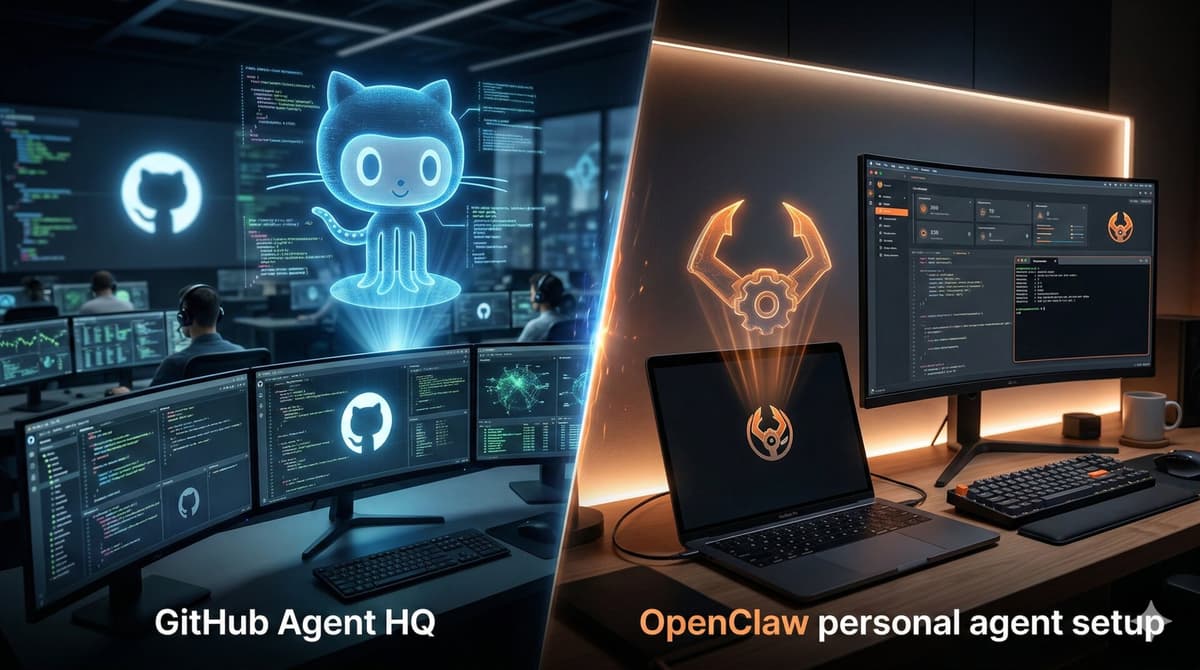
GitHub just went all-in on enterprise AI agents. But is their "Agent Control Plane" overkill for solo devs? Here's how it stacks up against a personal setup like OpenClaw.
The Agent Wars Just Escalated
What GitHub Agent HQ Actually Is
GitHub Agent HQ includes: Agent Control Plane for centralized monitoring, Agentic Workflows in sandboxed containers, Custom Agents with version-controlled definitions, and an MCP Registry for enterprise-wide allowlists.
What OpenClaw Actually Is
OpenClaw is a personal AI agent runner with local execution, tool integration (shell, browser, files), flexible triggering via cron and webhooks, and multi-provider support for any model.
Head-to-Head Comparison
GitHub Agent HQ: Enterprise setup, $400+/month for teams, centralized policies, comprehensive audit logs, sandboxed security, restricted tool access, built for compliance.
OpenClaw: Local install, $20-50/month, full user control, basic logging, trusted system access, unlimited tools, single-user focused, self-managed compliance.
Who Should Use What?
Choose GitHub Agent HQ if you are a 50+ person engineering org with compliance requirements, security demands, and centralized control over 100+ repositories.
Choose OpenClaw if you are a solo dev or small team (2-5 people), where speed matters more than audit trails, and you want full system access with cost optimization.
Bottom Line
Solo dev/small team: OpenClaw wins on flexibility, cost, and speed. Large enterprise: GitHub Agent HQ wins on governance and compliance. Best of both: Use GitHub for repo automation, OpenClaw for everything else.
Can I migrate agents between platforms?
Not directly — agent definitions and workflows are platform-specific. You'll need to rebuild agents when switching platforms.
Implementation notes from the engineering side
When I would use this in production, I would turn the idea into a repeatable debug path. GitHub Agent HQ vs OpenClaw: The Personal Agent Showdown should leave the reader with a command, fixture, checklist, or failure mode they can verify without guessing.
My review path is simple: connect the advice to one real workflow, make the risk visible, change only what is needed, and keep proof that the change worked.
Debugging checklist
- Create a small reproduction before editing the main codebase.
- Add logging or command output that proves the issue.
- Prefer a small fix over a broad rewrite.
- Test the failure case and the normal case.
- Document version, environment, and dependency assumptions.
Production risks I would test
- The fix works only for the demo case.
- The command succeeds locally but fails on the server.
- The article hides an environment assumption.
- No one can reproduce the bug after reading it.
Engineering review block
Debug checklist for GitHub Agent HQ vs OpenClaw: The Personal Agent Showdown:
- Reproduce the issue with a small fixture.
- Log the failing input and expected output.
- Patch the smallest responsible module.
- Add a regression test or repeatable command.
- Document the remaining production risk.
This block is meant to force a practical check before code, content, or client advice moves forward.
Next engineering improvement
To make this stronger over time, I would add proof from the workflow itself: a screenshot, log excerpt, metric table, source link, or concrete QA result.
For a shorter post, I would add depth through one tested example rather than filler. One good edge case or validation note is more useful than another generic overview.
- One real example from the workflow.
- One edge case that breaks the simple advice.
- One metric or signal to watch after the change.
- One clear action the reader can take today.
One implementation example
For GitHub Agent HQ vs OpenClaw: The Personal Agent Showdown, I would keep one concrete example in the page so the advice does not stay abstract. The example should show the starting state, the decision being made, the check I would run, and the signal that tells me the change worked. That makes the content more useful for readers and more defensible for SEO/AEO because it demonstrates practical experience instead of repeating a general claim.
- Starting state: what the store, app, workflow, or codebase looks like before the change.
- Decision point: what the reader needs to choose or fix.
- Validation: the command, screenshot, metric, support ticket, or QA step that proves the change.
- Risk: the edge case that could still fail in production.
- Follow-up: the next improvement I would make after the first pass is stable.
What to do next
The next step is deliberately small: test the idea on one real example, keep before/after evidence, then decide whether it deserves broader rollout.
Review path for github-agent-hq-vs-openclaw:
1. Pick one real example.
2. Apply the checklist.
3. Record before/after evidence.
4. Watch one metric or failure signal.
5. Keep or revert based on the result.
One implementation example
For GitHub Agent HQ vs OpenClaw: The Personal Agent Showdown, I would keep one concrete example in the page so the advice does not stay abstract. The example should show the starting state, the decision being made, the check I would run, and the signal that tells me the change worked. That makes the content more useful for readers and more defensible for SEO/AEO because it demonstrates practical experience instead of repeating a general claim.
- Starting state: what the store, app, workflow, or codebase looks like before the change.
- Decision point: what the reader needs to choose or fix.
- Validation: the command, screenshot, metric, support ticket, or QA step that proves the change.
- Risk: the edge case that could still fail in production.
- Follow-up: the next improvement I would make after the first pass is stable.
What to do next
The next step is deliberately small: test the idea on one real example, keep before/after evidence, then decide whether it deserves broader rollout.
Review path for github-agent-hq-vs-openclaw:
1. Pick one real example.
2. Apply the checklist.
3. Record before/after evidence.
4. Watch one metric or failure signal.
5. Keep or revert based on the result.Want this built for you instead of DIY?
I'm Karan — a Top Rated Plus Shopify Expert ($300K+ earned, 100% Job Success). If you'd rather hand this to someone who's done it hundreds of times, let's talk.
🛠️Generative AI Tools You Might Like
📬 Get notified about new tools & tutorials
No spam. Unsubscribe anytime.
Comments (0)
Leave a Comment
No comments yet. Be the first to share your thoughts!