Bandcamp Bans AI Music: A Turning Point for Generative Audio and Platform Policy
Bandcamp has officially drawn a line in the sand, barring music created substantially by AI. What does this mean for the future of Generative AI, developers, and the music industry?
The Policy: Human Artistry First
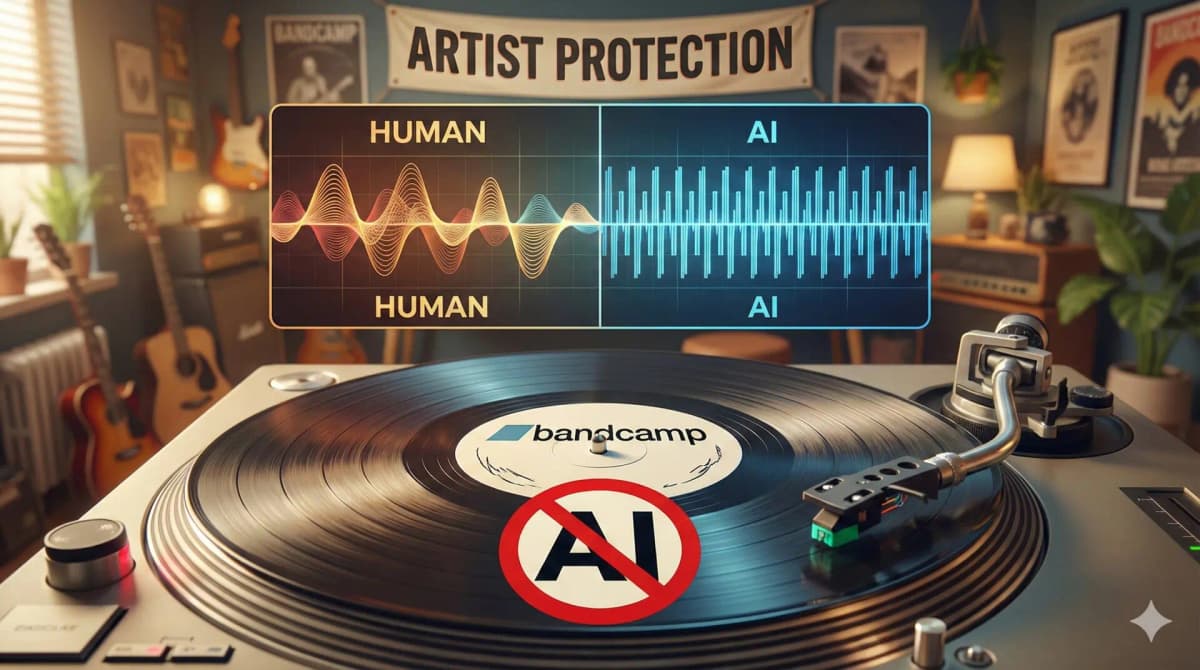
Bandcamp's new stance is explicit. The platform is doubling down on its identity as a community for human connection. Their statement emphasizes that while AI can be a tool, it cannot be the artist.
Specifically, they have banned content that constitutes "AI-generated music," defined as audio where the composition and recording are primarily the output of a generative model. Crucially, they have distinguished this from "AI-assisted" creation, acknowledging that technology has always played a role in production (from synthesizers to auto-tune).
Why This Matters for Developers
For those of us building or utilizing Generative AI applications, this distinction between Generation and Assistance is the new frontier of compliance.
- Platform Risk is Real: If you are building a business model solely around raw output from models like Suno or Udio, you are building on shaky ground. Platforms are beginning to curate against "slop"—low-effort, high-volume AI content.
- The "Human-in-the-Loop" Necessity: The most sustainable AI applications aren't those that replace humans, but those that empower them. Tools that help artists mix, master, or generate stems for further manipulation are likely to remain safe, whereas "text-to-completed-song" pipelines will find themselves segregated to specific AI-friendly platforms.
The Authenticity Economy
In e-commerce and digital sales, scarcity and story drive value. AI removes scarcity; it can generate infinite variations of a track in seconds. Bandcamp is betting that their customers pay for the story and the human effort behind the music, not just the audio waves.
This mirrors trends we see in other sectors. In content writing, Google is penalizing unedited AI spam. In visual art, copyright offices are rejecting works without substantial human authorship.
For e-commerce store owners using AI, the lesson is clear: Transparency is a premium feature. If you sell digital goods, certifying their human origin (or the extent of human involvement) is becoming a unique selling proposition (USP).
What About AI Impersonation?
Bandcamp also strictly prohibited using AI to impersonate artists. This touches on the legal hotbed of "Right of Publicity." We saw this with the "Fake Drake" controversy.
From a technical standpoint, developers must now consider Watermarking and Content Provenance. Technologies like C2PA (Coalition for Content Provenance and Authenticity) are going to become standard requirements for generative tools to prove that a piece of media is not a deepfake or unauthorized clone.
The Future of AI in Music
Does this mean AI music is dead? Absolutely not. It simply means the market is segmenting.
- The Purist Market: Platforms like Bandcamp will serve audiences seeking 100% human authenticity.
- The Functional Market: Stock music, background tracks for videos, and adaptive gaming audio will be dominated by AI because of cost and utility.
- The Hybrid Market: The most exciting space. Artists using AI to break writer's block, generate unique samples, or create new instruments, but retaining creative direction.
Conclusion
AI workflow review notes
For AI topics, I would separate what is confirmed, what is likely, and what still needs human review. Bandcamp Bans AI Music: A Turning Point for Generative Audio and Platform Policy should not ask the reader to trust hype; it should show how to evaluate the workflow safely.
My review path is simple: connect the advice to one real workflow, make the risk visible, change only what is needed, and keep proof that the change worked.
Human-review checklist
- Use primary sources for factual claims.
- Keep AI-generated output behind human review where risk exists.
- Log prompts or decisions when the workflow affects customers.
- Avoid sending data the task does not require.
- Measure whether AI made the workflow safer or only faster.
Where the model can mislead you
- The article treats a demo as production proof.
- The workflow hides data and review assumptions.
- The model output is trusted without validation.
- The post predicts too much and teaches too little.
Prompt-output review note
AI review checklist for Bandcamp Bans AI Music: A Turning Point for Generative Audio and Platform Policy:
- Separate confirmed facts from prediction.
- Name the data source.
- Describe the failure mode.
- Keep a human review step.
- Measure the workflow after shipping.
This block is meant to force a practical check before code, content, or client advice moves forward.
Next AI workflow improvement
To make this stronger over time, I would add proof from the workflow itself: a screenshot, log excerpt, metric table, source link, or concrete QA result.
For a shorter post, I would add depth through one tested example rather than filler. One good edge case or validation note is more useful than another generic overview.
- One real example from the workflow.
- One edge case that breaks the simple advice.
- One metric or signal to watch after the change.
- One clear action the reader can take today.
One human-review example
For Bandcamp Bans AI Music: A Turning Point for Generative Audio and Platform Policy, I would keep one concrete example in the page so the advice does not stay abstract. The example should show the starting state, the decision being made, the check I would run, and the signal that tells me the change worked. That makes the content more useful for readers and more defensible for SEO/AEO because it demonstrates practical experience instead of repeating a general claim.
- Starting state: what the store, app, workflow, or codebase looks like before the change.
- Decision point: what the reader needs to choose or fix.
- Validation: the command, screenshot, metric, support ticket, or QA step that proves the change.
- Risk: the edge case that could still fail in production.
- Follow-up: the next improvement I would make after the first pass is stable.
What to validate next
The next step is deliberately small: test the idea on one real example, keep before/after evidence, then decide whether it deserves broader rollout.
Review path for bandcamp-bans-ai-music-generative-audio-policy:
1. Pick one real example.
2. Apply the checklist.
3. Record before/after evidence.
4. Watch one metric or failure signal.
5. Keep or revert based on the result.Want this built for you instead of DIY?
I'm Karan — a Top Rated Plus Shopify Expert ($300K+ earned, 100% Job Success). If you'd rather hand this to someone who's done it hundreds of times, let's talk.
🛠️Generative AI Tools You Might Like
Tags
📬 Get notified about new tools & tutorials
No spam. Unsubscribe anytime.
Comments (0)
Leave a Comment
No comments yet. Be the first to share your thoughts!