Exploring the Frontier: Awesome LLM Apps, AI Agents, and RAG Architectures
Discover how LLMs, RAG, and AI Agents are revolutionizing software. Explore how we are building next-gen apps using OpenAI, Anthropic, Gemini, and open-source models.

The New Stack: Beyond the Prompt
Most "AI app" demos die the moment they leave the laptop. They look magic in a screen recording and fall apart on the second real user, because a raw model — GPT-4o, Claude 3.5 Sonnet, Gemini 1.5 Pro, doesn't matter which — has three problems you can't prompt your way out of: it makes things up, its knowledge stops at a training cutoff, and it can't touch your data or the outside world.
Everything worth building is about fixing those three things. The model is the easy part now. The stack around it is where the actual work lives.
RAG: giving the model your data
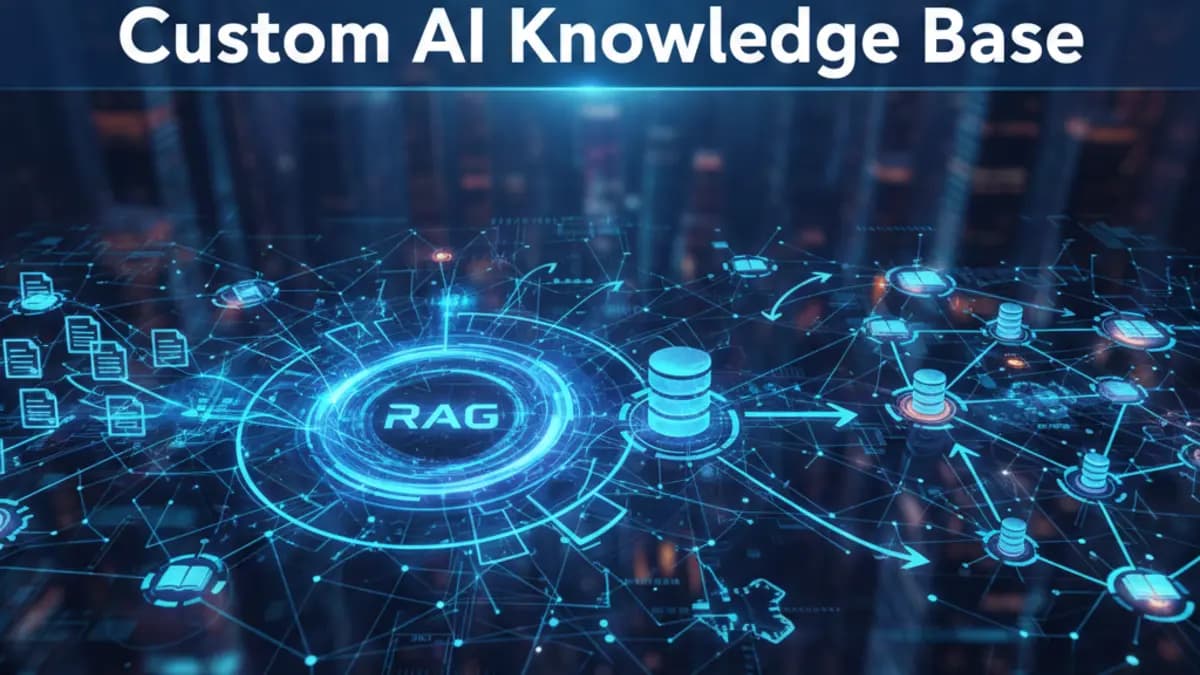
A base LLM has read most of the public internet and knows nothing about your business. RAG fixes that by pulling relevant context from your own data at query time and handing it to the model alongside the question.
The mechanics are unglamorous and that's fine. You chunk your documents, turn them into embeddings, store them in a vector database (Pinecone, Weaviate, Qdrant, or just pgvector if you don't want another piece of infra), and at query time you retrieve the closest chunks and stuff them into the prompt. The model answers from that context instead of from its memory, which is how you get answers that cite a source instead of confidently inventing one.
The part nobody warns you about: retrieval quality is the whole game. If your chunking is bad or your embeddings don't match how people actually phrase questions, the model gets garbage context and produces a confident, wrong, well-formatted answer. I've spent far more time tuning chunk size, overlap, and reranking than I ever have on prompts. I wrote up the full setup in implementing RAG for a custom AI knowledge base if you want the gritty version.
A concrete one: I built a support bot for a Shopify merchant that answers from their actual return policy, live inventory, and product docs instead of guessing. When it doesn't have the context, it says so and routes to a human — which matters more than people think, because a bot that hallucinates a refund policy is worse than no bot. (Same idea powers Ask Shopify, if you want to poke at one.) If you're starting from scratch, my website chatbot build guide covers the boring-but-load-bearing parts.
Agents: giving the model tools
RAG gives the model something to read. Agents give it something to do. An agent is an LLM wired to tools — APIs, a code interpreter, a browser, your database — plus the autonomy to decide when to reach for them.
A few patterns that actually ship:
- The researcher: takes a topic, searches the web (Serper, Tavily), reads the top results, and writes a summary with sources.
- The coder: writes code, runs it, reads the error, and fixes itself before handing anything back. Devin made this famous; OpenDevin and others do it in the open.
- The analyst: sits on top of a SQL database, answers questions in plain English, and returns a chart.
An aside on frameworks, because someone has to say it
Here's the unpopular take: most "agents" don't need an agent framework. Half the LangChain code I've inherited is a wrapper around a wrapper around a single tool_use API call, and the abstraction costs you more in debugging time than it ever saved you in setup.
If your "agent" is one model call that picks from three tools, write the loop yourself. Every major provider exposes native tool-calling now — you give it a list of functions, it returns which one to call with what arguments, you run it, you feed the result back. That's the entire pattern. You can read every line of it, which you will be grateful for at 2am when something breaks in production.
Reach for LangGraph or CrewAI when you genuinely have state to manage across many steps, or multiple agents that need to coordinate. Below that bar, plain API calls plus a while loop will outlast the framework's next breaking release. If you're standing up tooling for Claude specifically, MCP is worth a look — I went through the MCP servers I actually keep in my workflow elsewhere.
Picking the model
The "brain" matters, and the honest answer is that you'll switch between a few depending on the job:
- GPT-4o — still my default for agentic workflows. Follows multi-step instructions reliably and its function calling rarely surprises you, which is exactly what you want when a wrong call has side effects.
- Claude 3.5 Sonnet — what I reach for on coding and writing-heavy work. The 200k context window makes it strong for RAG over big documentation sets, and it tends to follow nuance better.
- Gemini 1.5 Pro — the context monster. Up to 2M tokens means you can sometimes skip RAG entirely and drop a whole codebase or a long video into the prompt. That's not a small convenience; it changes how you architect the thing.
Open source is real now
Llama 3 at 70B and 405B is close enough to proprietary performance that it's a serious option, especially when data can't leave the building. Running it locally with Ollama or inside a VPC with vLLM means your agent can work fully offline, no third-party API ever seeing the data. For privacy-sensitive clients that's frequently the deciding factor, not the benchmark scores.
Patterns worth your time
Multi-agent orchestration
One agent is useful. A small team of them is a different category. With CrewAI you can stand up a strategist, a writer, and an SEO specialist, hand them a goal, and let them critique each other's output before anything reaches you. Useful — but it multiplies your failure modes, so don't build a five-agent crew when one agent and a checklist would do.
Graph RAG
Standard RAG retrieves chunks by similarity, which is great for "find me the passage about X" and useless for "what are the main themes across these 500 documents?" Graph RAG (Microsoft's research pushed this forward) builds a knowledge graph so the system understands relationships between concepts, not just isolated chunks. It answers the global questions plain RAG can't. It's also more work to build and maintain, so use it when you actually have those questions to answer.
The part most posts skip
A demo working once is not proof of anything. Before any of this touches a customer, the questions I ask:
- Where did the fact come from? Cite the source or treat the answer as a guess.
- What happens when it's wrong? Every model output needs a failure mode you've actually thought about, not hoped against.
- Is there a human in the loop where the risk is real? Refunds, legal text, anything irreversible — yes.
- Are we sending data the task doesn't need? Usually the answer is "more than we should." Trim it.
- Did the AI make the workflow safer, or just faster? Faster-but-wrong is a downgrade.
Drop that into a checklist and keep it next to the code:
Ship checklist for an LLM feature:
- Separate confirmed facts from model guesses.
- Name the data source for every claim.
- Describe the failure mode before launch.
- Keep a human review step where risk is real.
- Measure the workflow after it ships, not before.
It's a small block of text and it catches most of the gap between a nice idea and something you'd actually put in front of users.
FAQ
Do I need a vector database to do RAG? For a small corpus, no — pgvector on a Postgres you already run is plenty. Reach for Pinecone or Qdrant when scale or filtering gets serious. Don't add infra you don't need yet.
LangChain or write it myself? If your agent is a handful of tool calls, write it yourself with native tool-calling and a loop. Pull in LangGraph or CrewAI when you have real multi-step state or several agents coordinating.
Which model should I start with? GPT-4o for reliable tool-calling, Claude 3.5 Sonnet for coding and long-document RAG, Gemini 1.5 Pro when you want to skip RAG and dump huge context. If data can't leave your environment, a local Llama 3.
Why does my RAG bot give wrong answers? Almost always retrieval, not the model. Check chunk size, overlap, and whether your embeddings match how users phrase questions. Add a reranking step before you blame the LLM.
Want this built for you instead of DIY?
I'm Karan — a Top Rated Plus Shopify Expert ($300K+ earned, 100% Job Success). If you'd rather hand this to someone who's done it hundreds of times, let's talk.
🛠️Generative AI Tools You Might Like
Tags
📬 Get notified about new tools & tutorials
No spam. Unsubscribe anytime.
Comments (0)
Leave a Comment
No comments yet. Be the first to share your thoughts!