Revolutionizing E-commerce Visuals: The Power of AI Image Generation
Discover how AI image generation transforms e-commerce by reducing costs and boosting creativity in product photography and marketing assets.
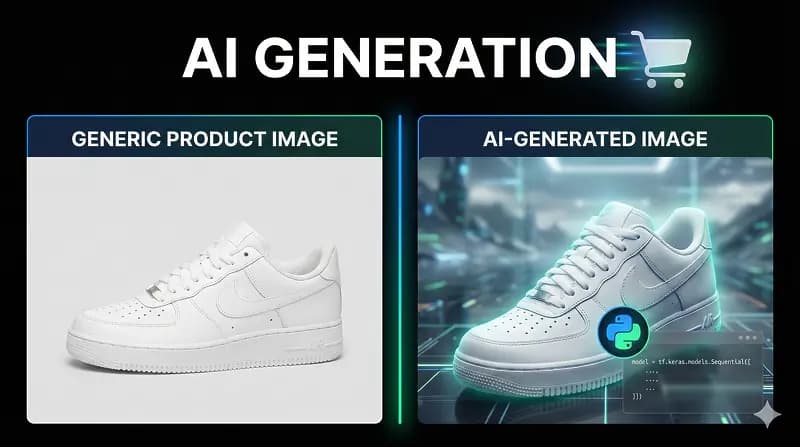
The Shift from Studio to Server
Traditionally, a product launch meant hiring a photographer, booking a studio, scouting models, and spending days on post-production editing. If you wanted to change the setting from a sunny beach to a cozy living room, you effectively had to reshoot.
Generative AI changes this paradigm. With tools like Midjourney, Stable Diffusion, and Adobe Firefly, you can now generate hyper-realistic lifestyle backgrounds, create unique marketing assets, and even virtually model clothing without a physical photoshoot.
Key Use Cases for E-commerce
1. AI-Enhanced Product Photography
The most immediate application is background generation. You can take a simple photo of your product against a white background and use AI to place it in endless contexts. Selling camping gear? Prompt the AI to place your tent in a misty forest or a rocky mountain peak. This allows for rapid A/B testing of visual themes to see what resonates with your audience without leaving your office.
2. Virtual Models and Fashion
For apparel brands, hiring models is a significant expense. AI tools can now generate diverse human models wearing your specific garments. New platforms and workflows allow you to upload a flat lay of a dress and see it draped naturally on models of different ethnicities, body types, and poses. This inclusivity not only saves money but increases conversion rates by helping customers visualize the product on themselves.
3. Infinite Marketing Creatives
Social media feeds demand a constant stream of fresh content. AI allows you to repurpose existing assets into new formats. You can extend image borders (outpainting) to fit Instagram Stories or generate entirely new conceptual art for brand awareness campaigns. The speed of iteration means you can react to viral trends in real-time.
Tools to Get Started
- Adobe Firefly: Excellent for commercial use as it's trained on Adobe Stock images, reducing copyright concerns. Its "Generative Fill" feature in Photoshop is a meaningful shift for quick edits.
- Midjourney: Known for its artistic and high-fidelity output. It is incredibly powerful for conceptual marketing shots and mood boards.
- Stable Diffusion: Offers the most control. When hosted locally or via specific apps, it allows for 'inpainting' and 'ControlNet', ensuring your product's shape and branding remain 100% accurate while changing the surrounding environment.
Best Practices and Pitfalls
While powerful, AI isn't magic. It requires skill to wield effectively.
- Preserve Product Integrity: Never use AI to alter the actual product features in a way that misrepresents it. Use AI for the context, not the item. The customer must receive exactly what they see online.
- Brand Consistency: Define a style guide for your prompts. Consistent lighting, color palettes, and moods are crucial to maintaining brand identity across AI-generated images.
- Legal Considerations: Be aware of the evolving legal landscape regarding AI copyright. Stick to commercially safe tools like Adobe Firefly for major campaign assets to mitigate risk.
Conclusion
How I Would Audit This
AI image generation can help ecommerce teams, but I would not use it to misrepresent the product. The safest use cases are backgrounds, lifestyle variants clearly based on the real product, campaign concepts, ad creatives, and internal moodboards.
- Separate product truth from creative context.
- Keep original product photography for PDP accuracy.
- Label or review AI assets where policy requires it.
- Check hands, text, logos, packaging, and material accuracy.
- Measure ad performance without polluting product expectations.
Production Failure Modes
The production bug is visual overpromising. If the AI image makes a product look larger, richer, smoother, or packaged differently than reality, returns and trust problems follow.
- Generated product details differ from shipped item.
- AI adds fake certifications or labels.
- Model photos imply fit or sizing not backed by data.
- Images include unreadable text or distorted logos.
- The brand loses a consistent visual style.
Copy/Paste Starting Point
Safe prompt frame:
Use the provided product photo as the source of truth.
Do not alter product shape, label, color, size, or material.
Generate only the background and lighting style.
Leave space for headline copy on the right.
That prompt makes the boundary explicit. The product remains the truth; AI changes the campaign setting.
What I Would Ship First
I would ship AI visuals first in ads and email tests, not as the only product-page media.
- Keep real product images on PDPs.
- Use AI for lifestyle/ad variations.
- Review every image against the physical product.
- Avoid generated text inside images unless manually checked.
- Track returns and customer complaints after visual changes.
Where buyers feel the difference
For ecommerce teams, I would connect this advice to buyer behavior and measurement. Revolutionizing E-commerce Visuals: The Power of AI Image Generation is only useful if it improves a decision point, reduces support confusion, or makes the buying path easier to trust.
The useful version of this advice is the version that survives a real project: one example, one validation step, one known edge case, and one clear next action.
Store measurement checklist
- Identify the buyer doubt this page or feature answers.
- Keep the first mobile viewport focused on the buying decision.
- Measure one primary outcome and one guardrail.
- Avoid adding apps or widgets before checking page speed.
- Use customer questions and support tickets as content input.
Where the store can lose trust
- The page adds more UI without reducing buyer doubt.
- The metric improves while returns or support tickets get worse.
- The content is generic across too many products.
- The recommendation is not tested on mobile.
Buyer-path review note
Measurement plan for Revolutionizing E-commerce Visuals: The Power of AI Image Generation:
- Primary metric: conversion or task completion.
- Guardrail: page speed, checkout errors, support tickets, or returns.
- Segment: mobile, desktop, new buyers, returning buyers.
- Review window: compare before/after only after enough traffic.
The point of the block is not formality; it is to make the assumption, proof, and remaining risk visible.
Where I would add more proof
The best future improvement is evidence. A page becomes more defensible when readers can see the command, check, screenshot, metric, or source behind the recommendation.
Want this built for you instead of DIY?
I'm Karan — a Top Rated Plus Shopify Expert ($300K+ earned, 100% Job Success). If you'd rather hand this to someone who's done it hundreds of times, let's talk.
🛠️Generative AI Tools You Might Like
Tags
📬 Get notified about new tools & tutorials
No spam. Unsubscribe anytime.
Comments (0)
Leave a Comment
No comments yet. Be the first to share your thoughts!