

Shopify Agentic Storefronts: What Developers Need to Know (March 2026)
Shopify just turned ChatGPT into a sales channel. Here's what this means for your store's architecture, data feeds, and checkout flows.
Shopify Agentic Storefronts: What Developers Need to Know
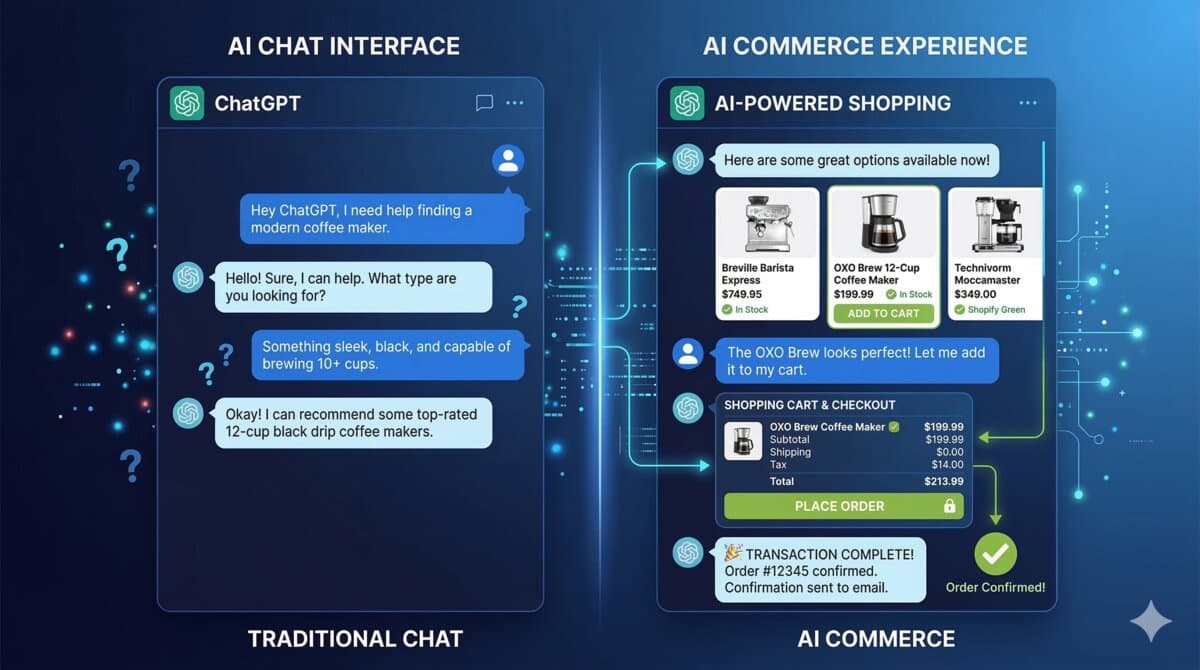
Last week, Shopify quietly announced something that changes everything about how we think about ecommerce infrastructure. ChatGPT is becoming a sales channel. Not a marketing channel. Not a support tool. A genuine, transaction-processing sales channel where customers can discover products and complete purchases without ever leaving their AI conversation.
This isn't speculative. Shopify confirmed to Modern Retail that "this agentic storefront channel will launch by default for your store, and you will be able to modify settings in your Admin."
Let me break down what this actually means for developers, what you need to prepare, and why this matters more than most Shopify announcements.
What Are Agentic Storefronts?
An agentic storefront is an AI-native sales channel where conversational agents (like ChatGPT, Claude, or Gemini) can browse your product catalog, answer customer questions, and complete transactions on behalf of users.
Think about the difference:
Traditional AI shopping: "Find me running shoes under $100" → AI gives recommendations → User clicks link → User buys on your site.
Agentic storefront: "Find me running shoes under $100" → AI browses catalog → AI shows options → "Buy the Nike Pegasus in my size" → Transaction completes inside the chat.
The shift is subtle but massive. The AI isn't just recommending — it's executing.
Why This Is a Structural Change, Not a Feature Update
Most Shopify updates are feature additions. New section types. Better analytics. Metafield expansions. You know the drill.
Agentic storefronts are different because they change the fundamental architecture assumptions of Shopify:
1. Product Data Feeds Become Critical Infrastructure
Right now, your product data needs to be good enough for humans browsing your store. With agentic storefronts, your data needs to be machine-readable at scale.
AI agents don't "browse" like humans. They consume structured data feeds. If your product descriptions are SEO-optimized prose but lack structured attributes (size, color, material, compatibility), agents can't match products to customer requests.
What this means: Your product catalog needs to be AI-optimized, not just human-optimized. Structured data, clear attributes, and comprehensive metafields become conversion requirements.
2. Real-Time Inventory Sync Is No Longer Optional
When an AI agent quotes availability to a customer, that data needs to be accurate. Stale inventory data means overselling, cancellations, and damaged trust.
Shopify's current API rate limits and webhook systems were designed for human-scale traffic. AI agents can query at machine speed. If your inventory sync relies on hourly batch updates, you're going to have problems.
What this means: Webhook-based inventory updates, proper cache invalidation, and potentially GraphQL subscriptions for real-time data become architectural requirements.
3. Checkout Flows Split Into Two Paths
Shopify's standard checkout is optimized for human users. It's been A/B tested to death. Every button placement, every trust signal, every progress indicator is designed for human psychology.
AI-driven checkout happens in conversation. The trust mechanisms, confirmation steps, and error handling are completely different. An AI that cancels mid-transaction because of a misunderstood confirmation prompt results in abandoned carts at scale.
What this means: You'll need to think about conversational checkout UX, not just web checkout UX. The same store now has two checkout experiences that both need optimization.
The Technical Implications for Developers
Let's get specific about what you'll actually need to build or modify:
Product Feed Optimization
Your product data needs to support AI consumption:
- Structured attributes in metafields — Not just "Blue shirt" but color: blue, shade: navy, material: cotton, weight: 200gsm, fit: slim
- Clear compatibility data — If you sell accessories, AI needs to know which models/versions they work with
- Natural language descriptions — AI can parse prose, but it needs to actually describe the product accurately
- Image alt text and metadata — Vision models will look at your product photos; alt text becomes part of the product understanding
API and Webhook Architecture
Current state: Most Shopify apps poll the REST API every few minutes. Webhooks handle real-time events.
Agentic future: You'll likely need:
- GraphQL Admin API for complex product queries with precise field selection
- Bulk Operations API for syncing large catalogs efficiently
- Webhook redundancy — Failed webhooks mean stale data, which means lost sales
- API versioning strategy — Shopify will iterate on this; backward compatibility matters
Order Attribution and Analytics
When a sale happens "through ChatGPT," how do you track it? Current Shopify attribution assumes traffic sources like Google, Facebook, or direct visits. AI agents break this model.
You'll need to:
- Track "Agentic Channel" as a distinct attribution source
- Understand which AI platform drove the sale (ChatGPT vs Claude vs Gemini)
- Analyze conversational funnel data (what questions led to conversion)
- Integrate AI attribution into your existing analytics stack
What Developers Should Do Now
The channel launches by default, but that doesn't mean you're ready. Here's a practical checklist:
Immediate (This Week)
- Audit your product data structure — Are your metafields comprehensive enough for AI queries?
- Review webhook reliability — Are you handling webhook retries properly? Any dropped inventory events?
- Check your API usage — Are you hitting rate limits already? Agentic traffic will increase API load.
Short-term (Next Month)
- Implement structured data improvements — Add product attributes as metafields, improve descriptions
- Set up GraphQL Admin API queries — Start migrating from REST where it makes sense
- Plan for conversational checkout — Design how your confirmation emails, receipts, and follow-ups work for AI-initiated purchases
- Test your inventory sync latency — Measure how long product availability changes take to propagate
Long-term (Next Quarter)
- Build analytics for agentic attribution — How will you know if AI is driving sales?
- Optimize for conversational discovery — What questions would customers ask an AI about your products?
- Consider AI-specific merchandising — Which products are most likely to be bought via conversation vs browsing?
The Competitive Implications
Here's the strategic angle: First-mover advantage in AI commerce is real.
When customers start asking ChatGPT "Where can I buy X?", AI agents will recommend stores based on:
- Product data completeness (can the AI actually understand what you sell?)
- Inventory reliability (does "in stock" mean in stock?)
- Checkout friction (can the AI complete the transaction smoothly?)
Stores optimized for agentic commerce will get recommended more often. This creates a virtuous cycle: more AI recommendations → more sales → more AI training data → more recommendations.
Stores that aren't optimized will become invisible to the fastest-growing shopping channel in history.
FAQs
Is this live yet?
Shopify announced the channel will launch "by default" but hasn't specified exact timing. The announcement came March 12, 2026, so implementation is likely rolling out gradually.
Will this work with my custom theme?
Agentic storefronts don't use your theme at all — they consume raw product data and complete transactions through APIs. Your theme only matters for traditional web traffic.
Do I need to build something to support this?
Technically no — Shopify is enabling it by default. But practically yes: if your product data is incomplete or your inventory sync is unreliable, you'll lose sales to competitors who optimized for AI.
How is this different from Shopify's existing Shop app?
The Shop app is Shopify's owned channel. Agentic storefronts are infrastructure that enables any AI platform (ChatGPT, Claude, Gemini, etc.) to sell your products.
What about fraud and abuse?
This is an open question. AI-initiated transactions introduce new fraud vectors (prompt injection attacks, AI hallucinations leading to incorrect purchases). Shopify's risk systems will need adaptation.
The Bottom Line
Agentic storefronts aren't just another sales channel to optimize. They're a fundamental shift in how commerce works — from human-driven discovery to AI-mediated fulfillment.
The developers who prepare now will have structural advantages when this goes fully live. The ones who wait will be playing catch-up in a market where AI recommendations increasingly determine merchant visibility.
Start with your product data. Fix your webhooks. Plan for conversational commerce. The AI shopping era is here — make sure your store is ready.
📬 Get notified about new tools & tutorials
No spam. Unsubscribe anytime.
Comments (0)
Leave a Comment
No comments yet. Be the first to share your thoughts!