Shopify Agentic Storefronts: What Developers Need to Know (March 2026)
Shopify's Agentic Storefronts let customers buy directly inside ChatGPT, Gemini, and Copilot. Here's what developers need to prepare for — product data, checkout flows, attribution, and API changes.
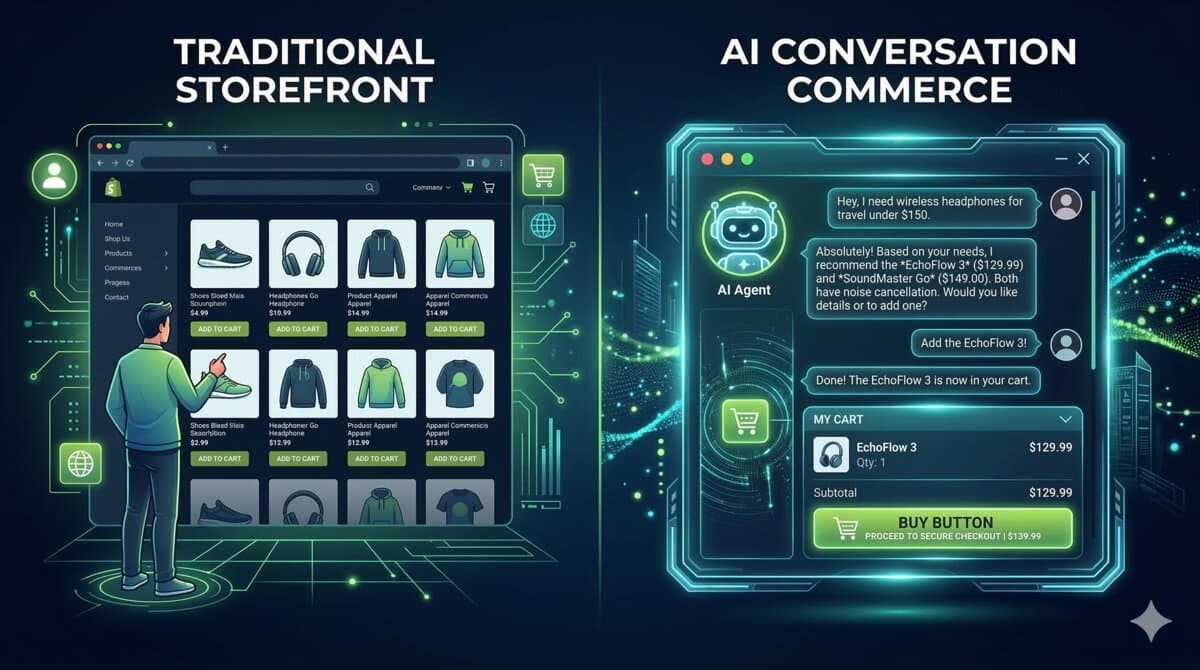
AI Just Became a Sales Channel, and Nobody Asked Your Permission
On March 11, 2026, Shopify emailed merchants to say a new "agentic storefront" channel would launch by default on their stores. Translation: your products are about to show up inside ChatGPT, Copilot, Google AI Mode, and Gemini, and people will be able to buy them without ever touching your theme. You didn't opt in. You can turn it off in Admin, but the default is on.
I've shipped Shopify builds for a decade and I've seen plenty of "this changes everything" announcements that changed almost nothing. This one is different, but not for the reasons most of the hype posts claim. The interesting part isn't a shiny new API you get to call. It's that an AI agent is now reading your product data and making buying decisions on a customer's behalf, and most stores have product data that's a mess.

So let me be blunt about what's real, what's speculation, and what you should actually do this week versus what you should ignore until Shopify ships docs.
What an agentic storefront actually does
A customer asks ChatGPT for, say, a gift for a coffee drinker. Today, the assistant hands them a few links and they bounce off to your store to check out. With the agentic channel, the assistant can surface your product and complete the purchase in the conversation. The buyer never lands on your storefront.
Here's the before and after, stripped of marketing language:
Before:
- Customer asks an AI for a recommendation
- AI returns links to Shopify stores
- Customer clicks, navigates, checks out on your site
- Attribution: external referral
After:
- Customer asks an AI for a recommendation
- AI shows your product with a buy action inline
- Customer checks out inside the conversation
- Attribution: a new agentic storefront channel
The reach is the part worth sitting with. Per Shopify's announcement, the same product data feeds ChatGPT, Microsoft Copilot, Google AI Mode, and Gemini. This isn't a ChatGPT integration. It's a single product surface fanning out to every major answer engine at once.
The honest part: this is a data problem wearing an AI costume
Every breathless take frames this as a new frontier of commerce design. It isn't. An agent can't see your hero animation, your sticky add-to-cart, or that clever section you spent two days on. It reads structured data. If a human can't tell from your data which variant fits, whether two products are compatible, or what your return rule is, an agent won't magically figure it out either.
That's the whole game. Clean, complete, machine-readable product data wins. Everything else is noise right now.
1. Product data is no longer "SEO stuff"
Your feed and structured data used to be a Google concern you could half-ass. Now they're how an agent understands and represents your inventory to a buyer who never sees your site.
What this means in practice:
- Structured data quality maps directly to whether an agent picks you
- Real-time inventory matters more than ever; an agent confidently selling an out-of-stock item is a refund and a bad review
- Descriptions need to answer buyer questions, not just rank for keywords
- Attributes (size, material, compatibility, capacity) have to be present and named in buyer language
Action this week: audit your Product JSON-LD. If it's incomplete or throwing validation errors, fix that before you think about anything else. I've written more on what answer engines actually reward in AI SEO tools for Shopify: what works in 2026.
2. A new attribution channel is coming
Shopify will almost certainly add reporting for the agentic channel. I wouldn't bet the house on exact field names yet, but expect:
- A new traffic source in Analytics
- New or modified
source_name/sourcevalues on orders - Possibly new webhook topics for agentic orders
- Different
referring_sitebehavior, since there often isn't a referring site
Action: look at any custom analytics or data pipeline you maintain. Anywhere you switch on source_name or assume a referrer exists, plan to handle an unknown value gracefully instead of dropping the order on the floor.
3. Checkout: redirect first, native later
"Checkout inside the conversation" could mean two things:
Option A: redirect to Shopify checkout. Buyer taps buy in the chat, lands on standard Shopify checkout. Boring, compliant, safe.
Option B: native in-agent checkout. The whole flow happens in the AI surface with Shopify handling payment. More powerful, much heavier on regulatory and fraud surface.
My money is on A first, then a measured move toward B. Shopify isn't going to hand payment capture to a third-party chat UI on day one. Either way, the lesson for you is the same: your checkout customizations need to survive in a stripped-down context with no theme around them.
Action: test that your Checkout UI Extensions, Functions, and post-purchase logic render and behave with minimal navigation. If you're building checkout customizations now, I've covered what's stable and what's shifting in Shopify checkout extensibility in 2026.
4. APIs and webhooks: prepare, don't build
New sales channels usually bring new order properties and sometimes new webhook topics. I'd guess something like a dedicated source_name, possibly new topics, maybe Sales Channel API updates. But that's a guess, and I'm flagging it as one. Don't write code against field names that don't exist yet.
Action: subscribe to the Shopify Developer Changelog and watch for the agentic storefront docs. Build when there's a spec, not before.
What to do now vs. what to ignore
Here's where I split from the "build everything immediately" crowd. Most of what you can do today is data hygiene, and that's good, because data hygiene pays off across Google, support, and shoppers regardless of whether agentic commerce lives up to the hype.
Do this week
Audit your Product structured data. Validate it. A correct, complete block looks like this:
<script type="application/ld+json">
{
  "@context": "https://schema.org",
  "@type": "Product",
  "name": "Your Product Name",
  "image": ["https://cdn.shopify.com/..."],
  "description": "A clear description that answers buyer questions",
  "sku": "SKU-123",
  "brand": { "@type": "Brand", "name": "Brand" },
  "offers": {
    "@type": "Offer",
    "price": "29.99",
    "priceCurrency": "USD",
    "availability": "https://schema.org/InStock"
  }
}
</script>
Review your inventory sync. How fresh is the stock data your channels see? Real-time webhooks or batch? If an agent can sell something you sold out of an hour ago, you have a latency problem to solve.
Document your checkout customizations. List every theme tweak, Function, Checkout UI Extension, and post-purchase extension. You want to know exactly what might break in a minimal context.
Do this month
Set up monitoring. Watch the changelog, subscribe to Editions notifications, keep an eye on the developer community. The docs will land with little warning.
Test checkout resilience. Verify checkout works with no theme navigation and via keyboard only, and that it's accessible. Agentic surfaces strip away the chrome you've been relying on.
Prepare analytics. Make your pipelines tolerant of new source values before they show up, not after they start corrupting reports.
Next quarter, if it proves out
Rewrite your top product descriptions for clarity and buyer questions. Prioritize your winners and high-margin SKUs. Evaluate whether your imagery and attributes give an agent enough to recommend you confidently.
Notice what's not on this list: building custom agent integrations, speculative API wrappers, or a "conversational commerce strategy" deck. There's no API to integrate against yet. Anyone selling you that today is selling vapor.
How I'd actually audit a store for this
I treat agentic readiness as an information architecture problem, not a new theme format. If agents are going to browse, compare, and recommend, the store needs clean data, stable URLs, structured content, and predictable buying flows.
- Product data is complete and consistent across the page, the schema, and your feeds.
- Variant options are named in buyer language ("12 oz / stainless steel"), not internal codes.
- Policies are crawlable and easy to quote verbatim.
- Collections explain how to choose, not just what's listed.
- Cart and checkout entry points stay conventional and don't depend on theme JavaScript to exist.
Where this breaks in production
Agentic commerce falls apart when the store is ambiguous. If a person can't tell which variant fits, whether two products work together, or what a return rule means, an assistant won't resolve it reliably. The common failure modes:
- Identical generic descriptions copy-pasted across dozens of SKUs.
- Missing size, material, ingredient, or compatibility attributes.
- Reviews rendered entirely client-side, invisible in the initial HTML.
- Policy pages written for lawyers, not buyers.
- No canonical URL for products that appear in many collections.
A planning template I use
Before touching content, I define the buyer question, then make sure the page answers it in structured form:
{
  "productIntent": "gift for coffee drinker",
  "requiredAttributes": ["capacity", "material", "dishwasherSafe", "giftPackaging"],
  "pageBlocks": ["who this is for", "care instructions", "shipping cutoff", "returns"]
}
This is the whole method. Start from what the buyer is trying to figure out, then guarantee the data has structured answers.
What I'd ship first
Better product information architecture, before any AI widget. Clean data helps Google, answer engines, your support team, and shoppers simultaneously, which makes it the rare bet that pays off no matter how agentic commerce shakes out.
- Normalize product attributes across the catalog.
- Add comparison and fit notes where buyers hesitate.
- Expose review summaries in the initial HTML.
- Validate Product schema and keep it valid.
- Track the long-tail questions showing up in Search Console and support chat, then answer them on the page.
If you're already experimenting with letting AI tools query your store directly, the Shopify Dev MCP server is a useful companion for testing how a model reads your catalog.
The bigger pattern
This isn't a one-off feature. It's Shopify continuing to bet that commerce is fragmenting across surfaces: web, mobile, social, and now AI conversations. Social commerce in 2024, AI-assisted recommendations in 2025, agentic checkout in 2026. Your Shopify work now spans all of them.
The merchants who win won't be the ones with the flashiest theme. They'll be the ones with pristine, real-time product data, checkout that works anywhere, and analytics that can see every touchpoint.
Timeline: what we actually know
- March 11, 2026 — Shopify emails merchants about the upcoming launch.
- "Soon" (per Shopify) — channel launches by default for all stores.
- TBD — full API documentation.
- TBD — developer preview access.
Current status: announcement phase. No developer documentation yet. This is the moment to clean up data and prepare, not to implement against APIs that don't exist.
Frequently Asked Questions
Will existing stores be opted in automatically?
Yes. Shopify's merchant email states the agentic storefront channel launches by default for your store. You don't have to do anything for your products to start appearing, which is exactly why auditing your product data now matters.
Can merchants turn it off?
Yes. Shopify has confirmed you'll be able to modify the channel settings in your Admin. So if you have a reason to stay out, say compliance constraints or a catalog that isn't ready, you can disable it. I'd recommend fixing your data rather than opting out, but the choice is there.
Is this connected to Shopify's OpenAI partnership?
Yes. Shopify has been working with OpenAI on this, and ChatGPT is one of the named surfaces. But it's not OpenAI-only; the same product data is set to appear across Microsoft Copilot, Google AI Mode, and Gemini.
When will developer documentation be released?
Unknown as of this writing. Based on how Shopify typically rolls out major channels, expect docs within a week or two of the announcement, but treat that as an estimate. Don't build against speculated field names until the official spec is published.
Do I need to build a custom integration to participate?
No. There's no integration to build today because no public API exists yet. Participation comes from having clean, complete, validated product data and a checkout that works in a minimal context. That's the work, and conveniently it's work that also helps your SEO, support, and conversion regardless of agentic commerce.
Bottom line
Right now there are almost no real developer guides for this, because there's almost nothing to integrate yet. That's the opportunity. The stores that treat product data as infrastructure, keep checkout working in any context, and stay close to the changelog will be ready the day the API ships. Everyone else will be scrambling to clean up their catalogs while the early movers are already selling inside conversations.
The work is unglamorous: normalize attributes, validate schema, fix inventory latency, document your checkout. Do that now and you're ready for whatever Shopify actually ships.
Based on Shopify's March 11, 2026 merchant announcement and public reporting. Official developer documentation is pending; I'll update this as the technical details land.
Want this built for you instead of DIY?
I'm Karan — a Top Rated Plus Shopify Expert ($300K+ earned, 100% Job Success). If you'd rather hand this to someone who's done it hundreds of times, let's talk.
📬 Get notified about new tools & tutorials
No spam. Unsubscribe anytime.
Comments (0)
Leave a Comment
No comments yet. Be the first to share your thoughts!