OpenClaw Joins OpenAI: What Happened, What People Think, and What It Means for the Future of AI Agents
Peter Steinberger had billion-dollar offers from OpenAI and Meta. He chose to become an employee instead. Here's what actually happened, community reactions, and predictions for AI agents.
A founder turned down billion-dollar acquisition offers to take a salaried job. If you want to understand where personal AI agents are actually heading, that one fact tells you more than any product roadmap.
Here's what didn't happen: OpenAI did not buy OpenClaw. Not the company, not the project. They hired Peter Steinberger, the guy who built it, as an employee. OpenClaw itself moves to an independent foundation that OpenAI will back from the outside.
That distinction is the whole story, and most of the early coverage botched it.
What he actually did
Steinberger's own words:
"I'm joining OpenAI to work on bringing agents to everyone. OpenClaw will move to an independent foundation — with OpenAI as a supporter."
The facts, stripped down:
- Steinberger joined OpenAI as an employee
- His brief, per Sam Altman: "drive the next generation of personal agents"
- OpenClaw stays open-source, moving to an independent foundation
- OpenAI keeps supporting that foundation
- He'd reportedly fielded billion-dollar acquisition offers from both OpenAI and Meta
And his reasoning, which I think is the most honest thing any founder has said this year:
"Yes, I could totally see how OpenClaw could become a huge company. And no, it wasn't an easy decision. But building agents for everyone matters more to me than building a company for myself."
A founder with working code, viral momentum, and real acquisition money on the table picked employment. You don't do that unless you genuinely believe the leverage lives somewhere other than your own cap table.
The backstory matters here
OpenClaw didn't start as a startup. It started as a playground project — something Steinberger built to mess around and improve his own life with AI. Then it went viral in weeks on the promise of being "the OS for AI agents." It went through names too: Clawdbot, then Moltbot, then OpenClaw. At one point the assistants started building their own social connections, an AI social network nobody planned for.
The whole thing was running on donations and limited corporate support, bleeding $10k-$20k a month. Then the billion-dollar bids showed up. He said no to the money and yes to the job.
If you've ever wired up agents yourself, that trajectory feels familiar — the best agent tooling tends to come from people scratching their own itch, not from a product spec. My practical guide to automating real workflows with AI leans on exactly that pattern.
The thing the internet got wrong
The r/singularity thread had the usual mix, but one comment cut through everything:
"They didn't acquire a thing. They hired a man who made a thing. The old thing will continue to exist as an open-source project."
That's it. OpenClaw-the-project lives. OpenClaw-the-billion-dollar-company never gets born. By design.
The other recurring note was security, and it's fair:
"OpenClaw was built so fast. It should be redone with security in mind from scratch."
Anyone who shipped fast knows the truth in that. OpenClaw is brilliant and built loose. Security was an afterthought, because of course it was — it started as a toy. That's not a knock, it's just what "built fast" buys you.
Where I think this goes
Short-term, the foundation formalizes with OpenAI sponsorship, Steinberger moves to the agent team, and the core contributors keep the lights on. Medium-term, I'd bet OpenClaw stops being a product and becomes a reference implementation — and Steinberger's OpenAI work produces something "OpenClaw-inspired" but rebuilt properly, security included.
Longer out, the foundation survives as the hacker's choice for agent frameworks while OpenAI ships its own consumer agent under a different name. Meta or someone forks an alternative. None of that is a stretch given where the pieces already sit.
On Steinberger's mandate specifically, Altman's "next generation of personal agents" is vague on purpose, but the direction isn't hard to read:
- ChatGPT agents get serious — the current ones are basic
- OS-level integration, native this time, the way OpenClaw hacked Mac and Windows
- Real file system access, because actual work happens in files, not chat
Steinberger's own bar is the one I keep coming back to: "build an agent that even my mum can use." That's the entire game. The jump from developer toys to something a non-technical person trusts daily is where most agent projects die. If you've tried to hand your own setup to someone who isn't a developer, you already know the gap.
What it means if you build agents
For agent startups, this validates the space and raises the floor at the same time. You're now competing with OpenAI plus Steinberger, Meta's rumored agent work, and Anthropic's computer use. The survivors go narrow — coding agents, research agents — or go deep into enterprise integrations where OpenAI moves slower, or they bet on open-source persistence.
For open-source, the foundation model is the genuinely interesting part. OpenAI sponsors an independent entity instead of owning it: keeps the project alive, keeps competitors from buying it, steers direction through money rather than control, and pulls in talent that wants mission alignment. If it works, expect it copied.
I've been running OpenClaw as my AI employee since late 2025 — multiple agents handling server monitoring, content, the boring operational stuff. From that seat, three things are obvious. The current implementation won't scale to "everyone's mom." OpenAI needs this, because their agents today are weaker than what OpenClaw already pulls off. And the foundation is the load-bearing piece — if it turns into a ghost project while OpenAI ships a proprietary clone, the whole arrangement was theater.
The opportunity is real though. Agents that actually do things — manage files, run commands, monitor systems, make content — are where this goes. If you want to see how far the open ecosystem already reaches, the awesome LLM apps roundup on AI agents and RAG is a good map, and the MCP servers I run in my own Claude workflow are how a lot of this gets wired together in practice.
The bottom line
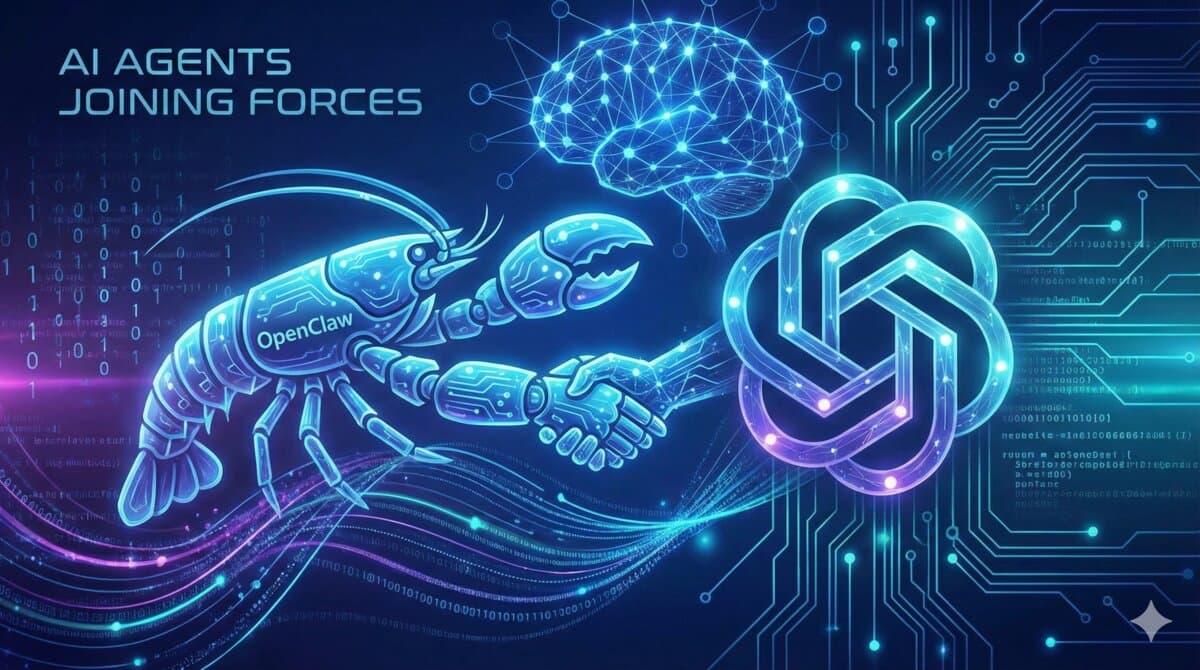
Steinberger signed off with "the claw is the law," and his crab mascot has become a bit of an icon in the agent crowd. Fine. The actual takeaway is colder: the AI agent timeline just compressed by 12-18 months because a founder with leverage chose mission over billions.
February 15, 2026 was the marker. Whether it reads as win-win or as the community being right to feel uneasy depends entirely on whether OpenAI's "support" is material or decorative. The next year settles it.
FAQ
Did OpenAI acquire OpenClaw? No. OpenAI hired Peter Steinberger as an employee. OpenClaw moves to an independent foundation that OpenAI supports from the outside, and it stays open-source.
Why turn down a billion-dollar offer for a job? Steinberger said building agents for everyone mattered more to him than building a company for himself. He reportedly had acquisition offers from both OpenAI and Meta.
What happens to OpenClaw now? It stays open-source under the new foundation. The likely path is that it becomes a reference implementation while OpenAI builds its own consumer agent separately.
Is OpenClaw safe to run? It was built fast, and security was not the priority early on — a point the community keeps raising. Treat it accordingly if you self-host it.
Karan Goyal is a Shopify Expert and AI tools enthusiast who runs OpenClaw as his AI employee at karangoyal.cc.
Want this built for you instead of DIY?
I'm Karan — a Top Rated Plus Shopify Expert ($300K+ earned, 100% Job Success). If you'd rather hand this to someone who's done it hundreds of times, let's talk.
📬 Get notified about new tools & tutorials
No spam. Unsubscribe anytime.
Comments (0)
Leave a Comment
No comments yet. Be the first to share your thoughts!