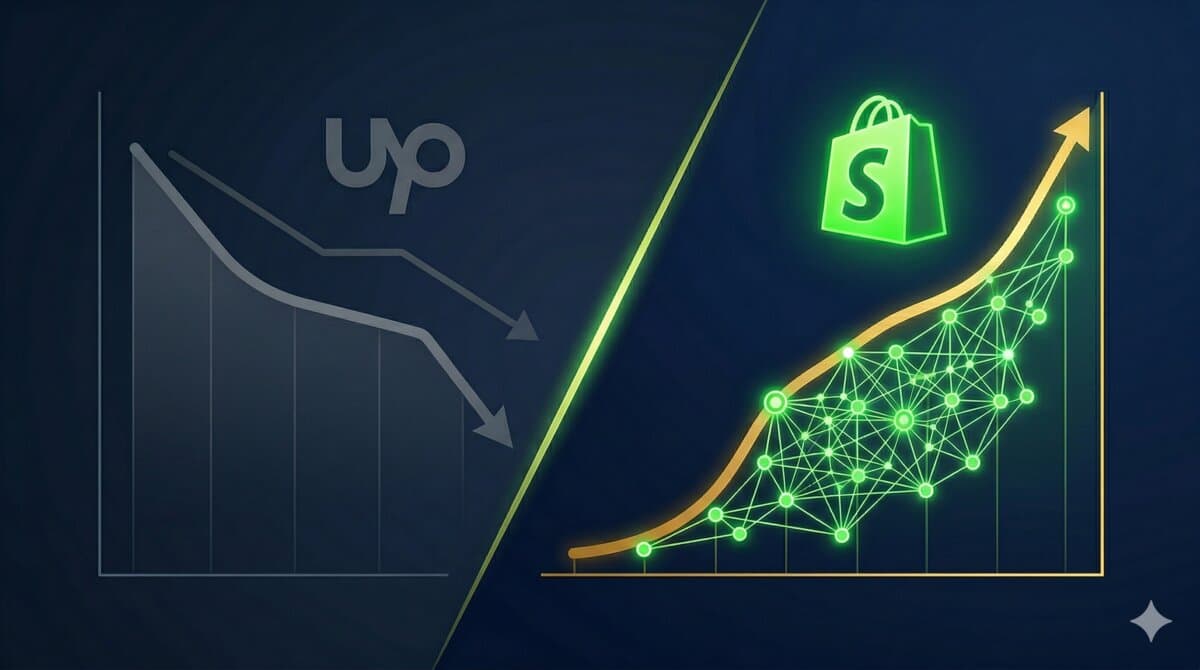
Freelance-Pocalypse? Upwork Crashes 23% — Your 2026 Survival Playbook
Upwork stock plummeted 23% after disappointing Q1 guidance. Here is the 70/30 survival rule and 5 strategies for thriving in the AI-driven freelance economy.
The Numbers Do not Lie
Here is what happened:
- Stock drop: ~23% in one day
- Q1 EPS guidance: $0.26-$0.28 per share (missed consensus of $0.34)
- Goldman Sachs lowered price target to $27
Why This Is the Freelance-Pocalypse
The Upwork crash mirrors the broader SaaS selloff of 2022-2023. In both cases, the threat is not immediate revenue loss—it is the structural fear that AI will fundamentally replace the business model.
Upwork is guidance miss signals that growth is slowing not because of competition, but because demand for human freelance labor is plateauing as AI tools get better. A client who once hired a freelance writer for $500 can now get 80% of the value from Claude or ChatGPT for $20/month.
The 70/30 Rule: Your New Operating System
Here is the framework that separates freelancers who stay stuck from those who scale:
- 70% of your time: Client work (pays the bills)
- 30% of your time: Building your own assets (buys your freedom)
That 30% is not someday work. It is non-negotiable. Every week, you are building something you own: digital products, tools, content, or a micro-SaaS.
5 Survival Strategies
1. Move Upmarket: Sell Strategy, Not Just Execution
The $15/hour content writer is being replaced by AI. The $150/hour content strategist who knows which content to create, why it matters, and how it fits into a growth system? That person is more valuable than ever.
2. Become the AI Operator, Not a Competitor
AI is not your enemy. It is your force multiplier. The freelancers winning right now use ChatGPT, Claude, MidJourney, and Cursor to deliver 10x faster without sacrificing quality.
3. Specialize in Niches AI Cannot Touch
AI struggles with emotional intelligence, complex stakeholder management, taste and judgment, and regulated/high-stakes work. The narrower your specialization, the less likely AI can replace you.
4. Diversify Off Platforms
Upwork owns your client data. Build your own website, email list, LinkedIn presence, and case studies. Your portfolio should work 24/7, not just when you are actively bidding.
5. Own Your Client Relationships
Every client you land on a platform should eventually become a direct client. This week, email three past clients and offer them a direct rate. Two will say yes.
The Bottom Line
The freelance economy is bifurcating: the bottom is commoditized AI-replaceable work, and the top is high-judgment relationship-driven expertise.
The freelancers who thrive will not be the cheapest. They will be the ones who know which AI tool to use, when to use it, and—most importantly—when to apply human judgment that no algorithm can replicate.
The freelance-pocalypse is not coming. It is here. The question is: are you going to adapt, or compete with robots on price?
What is the 70/30 rule and how can it help with Upwork freelance survival?
The 70/30 rule is a framework that separates freelancers who stay stuck from those who scale, by allocating 70% of their time to client work and 30% to building their own assets. This rule is essential for Upwork freelance survival as it allows freelancers to build their own assets, such as digital products, tools, and content, and create a safety net against the uncertainties of the freelance market. By prioritizing this 30% of their time, freelancers can create a more sustainable and resilient business model.
Client-work notes
For freelance work, the practical value is in making expectations explicit. Freelance-Pocalypse? Upwork Crashes 23% — Your 2026 Survival Playbook should help a developer or client avoid ambiguity, not just feel motivated for a few minutes.
My review path is simple: connect the advice to one real workflow, make the risk visible, change only what is needed, and keep proof that the change worked.
Scope and communication checks
- Write the business outcome in plain language.
- Name assumptions beside estimates.
- Separate urgent from important work.
- Show proof of completion with screenshots, tests, or notes.
- Close the loop with a clear next decision.
Where projects go off track
- The advice is too broad to change behavior.
- Scope or risk is discussed too late.
- The client receives output but not context.
- The developer underprices uncertainty.
Scope note template
Quality check for Freelance-Pocalypse? Upwork Crashes 23% — Your 2026 Survival Playbook:
- What changed for the reader?
- What proof supports the advice?
- What should be avoided?
- What is the next practical action?
This block is meant to force a practical check before code, content, or client advice moves forward.
Next client-facing improvement
To make this stronger over time, I would add proof from the workflow itself: a screenshot, log excerpt, metric table, source link, or concrete QA result.
For a shorter post, I would add depth through one tested example rather than filler. One good edge case or validation note is more useful than another generic overview.
- One real example from the workflow.
- One edge case that breaks the simple advice.
- One metric or signal to watch after the change.
- One clear action the reader can take today.
One project workflow example
For Freelance-Pocalypse? Upwork Crashes 23% — Your 2026 Survival Playbook, I would keep one concrete example in the page so the advice does not stay abstract. The example should show the starting state, the decision being made, the check I would run, and the signal that tells me the change worked. That makes the content more useful for readers and more defensible for SEO/AEO because it demonstrates practical experience instead of repeating a general claim.
- Starting state: what the store, app, workflow, or codebase looks like before the change.
- Decision point: what the reader needs to choose or fix.
- Validation: the command, screenshot, metric, support ticket, or QA step that proves the change.
- Risk: the edge case that could still fail in production.
- Follow-up: the next improvement I would make after the first pass is stable.
What to clarify next
The next step is deliberately small: test the idea on one real example, keep before/after evidence, then decide whether it deserves broader rollout.
Review path for freelance-pocalypse-upwork-crash-survival-playbook:
1. Pick one real example.
2. Apply the checklist.
3. Record before/after evidence.
4. Watch one metric or failure signal.
5. Keep or revert based on the result.Want this built for you instead of DIY?
I'm Karan — a Top Rated Plus Shopify Expert ($300K+ earned, 100% Job Success). If you'd rather hand this to someone who's done it hundreds of times, let's talk.
Tags
📬 Get notified about new tools & tutorials
No spam. Unsubscribe anytime.
Comments (0)
Leave a Comment
No comments yet. Be the first to share your thoughts!