Running Django Development Server with HTTPS using Ngrok
Learn how to serve your Django application over HTTPS during development using ngrok and django-sslserver.
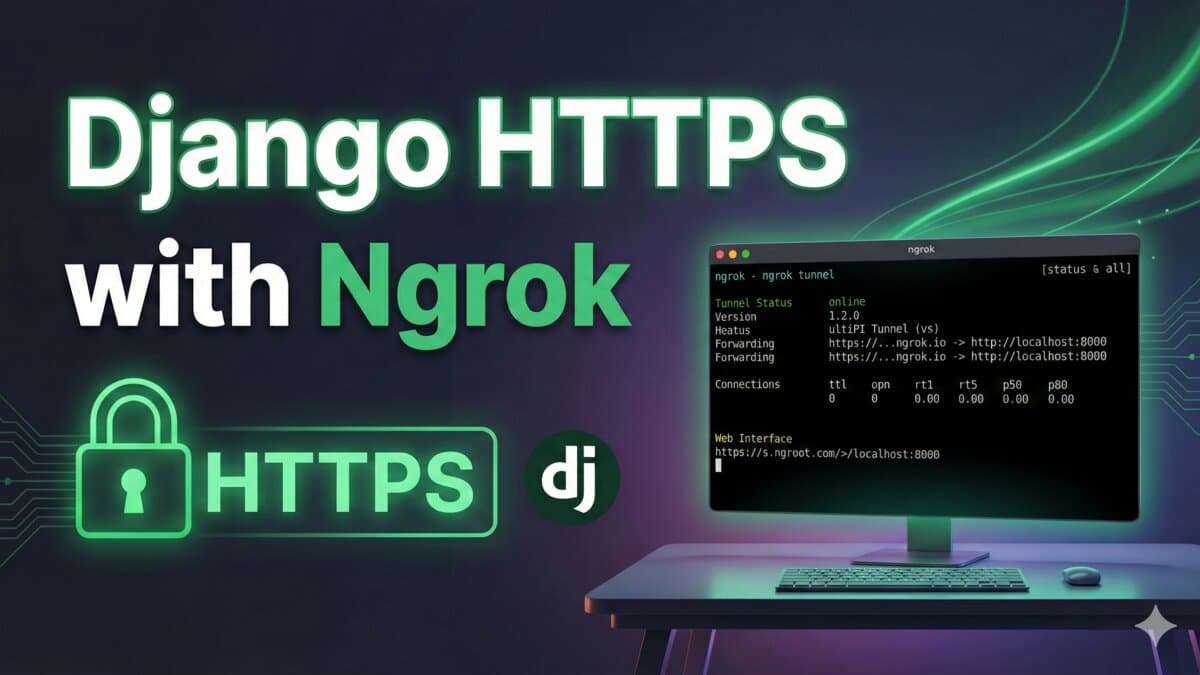
Introduction
When developing web applications with Django, it's often necessary to test features that require HTTPS, such as payment gateways or OAuth authentication. By default, Django's development server runs over HTTP, making it challenging to test these features locally. In this post, we'll explore how to serve your Django application over HTTPS during development using ngrok and django-sslserver.
Step 1: Generate Self-Signed Certificates
To serve your Django application over HTTPS, you'll need a certificate and private key. You can generate self-signed certificates using the mkcert tool. First, install mkcert using Homebrew by running:
brew install mkcertThen, install the root CA in your system's trust store:
mkcert -installGenerate a certificate and private key for localhost:
mkcert -cert-file cert.pem -key-file key.pem localhost 127.0.0.1Step 2: Install django-sslserver
To serve your Django application over HTTPS, you'll need to install the django-sslserver package. Run the following command:
pip install django-sslserverAdd 'sslserver' to your INSTALLED_APPS in settings.py:
INSTALLED_APPS = [
    ...
    'sslserver',
]
Step 3: Run Django Development Server with HTTPS
You can now run your Django development server with HTTPS using the following command:
python manage.py runsslserverBy default, runsslserver will use the certificate and private key generated earlier.
Step 4: Expose Your Local Server to the Internet using Ngrok
To expose your local server to the internet, you'll need to use ngrok. Run the following command:
ngrok http https://localhost:8000Ngrok will create a tunnel to your local server, allowing you to access it from anywhere.
Conclusion
In this post, we demonstrated how to serve your Django application over HTTPS during development using ngrok and django-sslserver. By following these steps, you can test features that require HTTPS locally, making your development workflow more efficient.
My practical engineering read
When I would use this in production, I would turn the idea into a repeatable debug path. Running Django Development Server with HTTPS using Ngrok should leave the reader with a command, fixture, checklist, or failure mode they can verify without guessing.
I would not leave this as theory. I would apply it to one actual page, integration, bug, or client decision and keep the evidence beside the recommendation.
Implementation review list
- Create a small reproduction before editing the main codebase.
- Add logging or command output that proves the issue.
- Prefer a small fix over a broad rewrite.
- Test the failure case and the normal case.
- Document version, environment, and dependency assumptions.
Debug cases to include
- The fix works only for the demo case.
- The command succeeds locally but fails on the server.
- The article hides an environment assumption.
- No one can reproduce the bug after reading it.
Production check template
Debug checklist for Running Django Development Server with HTTPS using Ngrok:
- Reproduce the issue with a small fixture.
- Log the failing input and expected output.
- Patch the smallest responsible module.
- Add a regression test or repeatable command.
- Document the remaining production risk.
A short review block like this is often enough to catch the gap between a nice idea and a safe production change.
Next production check
I would keep improving this page by replacing any remaining abstraction with artifacts from actual work: test output, screenshots, metrics, source references, or before/after notes.
For a shorter post, I would add depth through one tested example rather than filler. One good edge case or validation note is more useful than another generic overview.
- One real example from the workflow.
- One edge case that breaks the simple advice.
- One metric or signal to watch after the change.
- One clear action the reader can take today.
A practical engineering scenario
For Running Django Development Server with HTTPS using Ngrok, I would keep one concrete example in the page so the advice does not stay abstract. The example should show the starting state, the decision being made, the check I would run, and the signal that tells me the change worked. That makes the content more useful for readers and more defensible for SEO/AEO because it demonstrates practical experience instead of repeating a general claim.
- Starting state: what the store, app, workflow, or codebase looks like before the change.
- Decision point: what the reader needs to choose or fix.
- Validation: the command, screenshot, metric, support ticket, or QA step that proves the change.
- Risk: the edge case that could still fail in production.
- Follow-up: the next improvement I would make after the first pass is stable.
Implementation summary
Do not scale the advice blindly. Prove it on one useful case, watch the result, then decide whether to repeat it.
Review path for django-localserver-https-ngrok:
1. Pick one real example.
2. Apply the checklist.
3. Record before/after evidence.
4. Watch one metric or failure signal.
5. Keep or revert based on the result.
A practical engineering scenario
For Running Django Development Server with HTTPS using Ngrok, I would keep one concrete example in the page so the advice does not stay abstract. The example should show the starting state, the decision being made, the check I would run, and the signal that tells me the change worked. That makes the content more useful for readers and more defensible for SEO/AEO because it demonstrates practical experience instead of repeating a general claim.
- Starting state: what the store, app, workflow, or codebase looks like before the change.
- Decision point: what the reader needs to choose or fix.
- Validation: the command, screenshot, metric, support ticket, or QA step that proves the change.
- Risk: the edge case that could still fail in production.
- Follow-up: the next improvement I would make after the first pass is stable.
Implementation summary
Do not scale the advice blindly. Prove it on one useful case, watch the result, then decide whether to repeat it.
Review path for django-localserver-https-ngrok:
1. Pick one real example.
2. Apply the checklist.
3. Record before/after evidence.
4. Watch one metric or failure signal.
5. Keep or revert based on the result.Want this built for you instead of DIY?
I'm Karan — a Top Rated Plus Shopify Expert ($300K+ earned, 100% Job Success). If you'd rather hand this to someone who's done it hundreds of times, let's talk.
🛠️Web Development Tools You Might Like
Tags
📬 Get notified about new tools & tutorials
No spam. Unsubscribe anytime.
Comments (0)
Leave a Comment
No comments yet. Be the first to share your thoughts!